Is Indian Psyllium Better Than Other Origins?
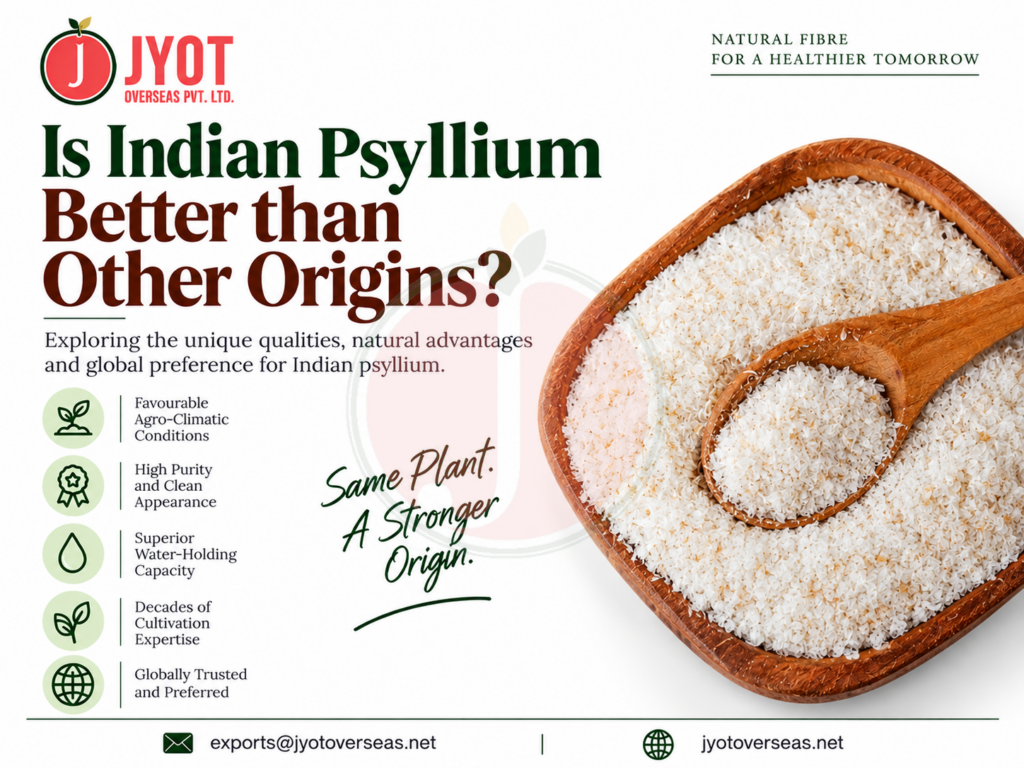
Is Indian Psyllium Better Than Other Origins? A Buyer’s Guide to Quality and Sourcing In the global psyllium market, one question frequently comes up among ingredient buyers: Is Indian psyllium better than psyllium from other origins? India is a major source of psyllium, also known as Isabgol, supplying psyllium husk and psyllium husk powder to international food, nutraceutical, pharmaceutical, and wellness industries. Its established cultivation base, processing expertise, and export experience make Indian psyllium an important choice for global ingredient sourcing. However, the real answer depends on more than geographical origin. Cultivation conditions, raw material selection, processing technology, quality testing, and manufacturing controls all influence the final product. For international buyers looking for a reliable psyllium manufacturer in India, understanding these factors is essential to making an informed sourcing decision. Why Is Indian Psyllium Important in the Global Market? India has a long-established psyllium cultivation and processing industry, supported by agricultural expertise, specialized manufacturing facilities, and an experienced export supply chain. Several factors contribute to the importance of Indian psyllium in international markets. 1. Established Psyllium Cultivation Psyllium cultivation has a strong agricultural base in India, particularly in Gujarat and Rajasthan. This established sourcing network supports the availability of psyllium seed for processing into husk, powder, and other product grades. For bulk buyers, an established cultivation base can be an important consideration when evaluating raw material availability and long-term supply potential. 2. Specialized Processing Expertise Producing consistent psyllium ingredients requires more than sourcing agricultural raw material. Cleaning, separation, grading, milling, sieving, and quality verification all influence the finished product. Experienced Indian psyllium manufacturers have developed processing capabilities to supply different grades according to customer specifications and intended applications. 3. A Wide Range of Psyllium Products Indian suppliers offer different psyllium products for diverse industrial requirements, including: Psyllium husk in different purity grades Psyllium husk powder in different mesh sizes Psyllium seed and seed powder Conventional and certified organic psyllium, subject to product and certification availability Specialized grades developed to meet customer specifications This product range allows international buyers to evaluate suppliers according to their formulation, processing, and regulatory requirements. 4. Experience in International Trade Global ingredient markets require suppliers to manage product specifications, export documentation, packaging, shipment planning, and customer-specific requirements. Experienced Indian psyllium exporters understand the importance of coordinating these requirements to support dependable international supply. Indian Psyllium vs. Other Origins: What Should Buyers Compare? The question of whether Indian psyllium is better than other origins should be evaluated through measurable product and supplier criteria rather than origin alone. Evaluation factor What buyers should check Purity Actual purity percentage and test method Swelling performance Swelling value under a defined testing method Particle size Mesh size and particle-size distribution Colour Agreed colour specifications and measurement method Microbiological quality Results against applicable specifications Contaminant control Relevant pesticide residues, heavy metals, and other risk-based tests Processing standards Cleaning, milling, segregation, and process controls Traceability Batch identification and raw material records Documentation Specifications, COA, certificates, and applicable regulatory documents Supply reliability Production capacity, lead time, and consistency across shipments These parameters help buyers make a more meaningful comparison between suppliers and origins. The key point: Indian origin can offer established sourcing and processing advantages, but the suitability of any psyllium ingredient must be confirmed through product specifications, testing, and supplier evaluation. Why Quality-Controlled Processing Matters More Than Origin Alone Psyllium is a functional ingredient, and its performance can affect the final application. Two products from the same country may perform differently because of variations in raw material, purity, particle size, processing, and testing methods. A reliable quality-control process typically covers: Cultivation → Raw Material Selection → Cleaning → Processing → Testing → Finished Product Approval → Documentation → Shipment For example, a food manufacturer may prioritize purity, swelling performance, microbiological quality, and particle size. A pharmaceutical or nutraceutical buyer may have additional requirements relating to contaminants, documentation, traceability, and regulatory compliance. Therefore, selecting the right psyllium husk supplier requires a clear understanding of the product’s intended use and the specifications that matter most to its performance. Jyot Overseas: An Exclusive Psyllium Manufacturer and Exporter At Jyot Overseas, we focus on supplying psyllium ingredients with defined specifications for international customers across food, nutraceutical, pharmaceutical, and wellness applications. As an Indian psyllium manufacturer and exporter, our product portfolio includes psyllium husk and psyllium husk powder, with grades and specifications considered according to customer requirements and product availability. Our approach emphasizes: Quality-focused processing and product consistency Defined product specifications and quality verification Appropriate testing and batch documentation Traceability and responsible sourcing initiatives Customer-specific product and export requirements Reliable coordination for international shipments We recognize that global buyers need more than a supplier based in a particular country. They need a manufacturing partner who understands their quality expectations, intended applications, documentation requirements, and long-term sourcing objectives. That is why our focus extends beyond Indian origin to the controls and processes that help deliver consistent psyllium ingredients. How to Choose the Right Psyllium Supplier in India When evaluating a psyllium supplier, international buyers should consider the following questions: Can the supplier meet the required purity, mesh size, and swelling specifications? Are product quality and testing methods clearly defined? Does the manufacturer operate suitable food safety and quality systems? Can the supplier provide relevant certificates and export documentation? Are batch traceability and quality records available? Can the supplier support the required volumes, packaging, and shipment schedules? Is the supplier equipped to support long-term business requirements? Comparing suppliers against these criteria provides a stronger basis for procurement decisions than choosing by country of origin or price alone. For businesses sourcing bulk psyllium husk from India, a supplier’s ability to meet specifications consistently is particularly important for maintaining product performance across production runs. Frequently Asked Questions Is Indian psyllium better than psyllium from other countries? Indian psyllium is valued for its established cultivation base, processing expertise, and export experience. However, quality varies by supplier, grade, and processing controls. Buyers should compare verified specifications and test results rather than relying on
Carbon Footprint of Psyllium: Building a More Sustainable Psyllium Supply Chain
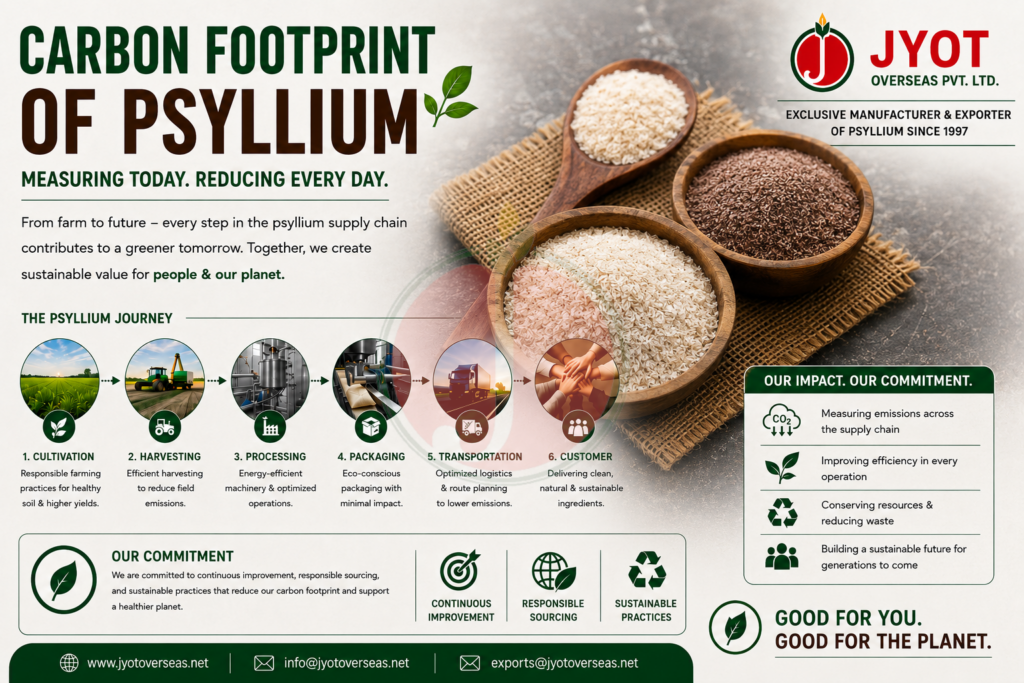
Carbon Footprint of Psyllium: Building a More Sustainable Psyllium Supply Chain As global food, nutraceutical, pharmaceutical, and wellness industries move toward more responsible sourcing, the carbon footprint of psyllium is becoming an increasingly relevant consideration for ingredient buyers. Psyllium is a plant-based functional ingredient widely used in dietary supplements, digestive health products, gluten-free foods, bakery applications, pharmaceuticals, and nutraceutical formulations. However, like any agricultural ingredient, its environmental footprint is influenced by multiple stages—from cultivation and harvesting to processing, packaging, and transportation. For global buyers, understanding these stages can help support more responsible and efficient ingredient supply chains. What Influences the Carbon Footprint of Psyllium? The environmental impact of psyllium does not come from a single stage. It is influenced by the complete supply chain: Cultivation → Harvesting → Processing → Packaging → Transportation → Customer Each stage presents opportunities to improve resource efficiency and reduce avoidable environmental impact. 1. Psyllium Cultivation Agricultural practices are an important part of the overall sustainability profile of psyllium. Responsible agricultural sourcing, efficient use of resources, appropriate cultivation practices, and better farm-level management can contribute to a more responsible psyllium supply chain. For psyllium buyers, supplier transparency around agricultural sourcing can therefore become an important part of sustainability evaluation. 2. Harvesting and Raw Material Handling Efficient harvesting and handling practices can help minimize unnecessary material losses and improve the utilization of agricultural raw material. Better raw material management also supports consistent quality while reducing avoidable waste throughout the supply chain. 3. Psyllium Processing and Manufacturing Processing is another important stage when evaluating the carbon footprint of psyllium. Energy consumption, processing efficiency, equipment utilization, resource management, and waste control can all influence the environmental performance of a psyllium manufacturing operation. At Jyot Overseas, our focus as an Indian psyllium manufacturer and exporter includes improving operational efficiency, optimizing resource utilization, reducing avoidable waste, and maintaining consistent product quality for international customers. 4. Packaging Efficiency Packaging contributes to the environmental footprint of any ingredient supply chain. Efficient packaging selection, material utilization, handling, and shipment planning can help reduce unnecessary material consumption while protecting the product during international transportation. For bulk psyllium buyers, packaging efficiency can also contribute to better container utilization and overall logistics efficiency. 5. Transportation and Logistics Transportation is another significant consideration when assessing the carbon footprint of psyllium. Psyllium supplied from India to international markets may involve multiple logistics stages, including inland transportation, port handling, ocean freight, and final delivery. Efficient shipment planning, appropriate container utilization, consolidation where practical, and optimized logistics can help reduce avoidable transportation impacts. Why Sustainable Psyllium Sourcing Matters to Global Buyers Sustainability is increasingly being evaluated alongside traditional supplier requirements. Global ingredient buyers may consider: Product quality and consistency Food safety and manufacturing standards Traceability Responsible agricultural sourcing Supply-chain transparency Resource efficiency Waste reduction Packaging practices Logistics efficiency Long-term supply reliability Therefore, sustainable psyllium sourcing is becoming broader than simply purchasing a plant-based ingredient. It involves understanding how the ingredient is cultivated, processed, packed, and delivered. Jyot Overseas: Sustainable Psyllium Supply from India As an established Indian psyllium manufacturer and exporter, Jyot Overseas works with a supply-chain approach that considers quality, responsible sourcing, operational efficiency, and long-term customer requirements. Our approach to sustainable psyllium supply focuses on: ✅ Responsible agricultural sourcing ✅ Efficient harvesting and processing practices ✅ Optimized energy and resource utilization ✅ Reduction of avoidable material and product waste ✅ Efficient packaging practices ✅ Shipment and logistics optimization ✅ Supply-chain traceability and transparency ✅ Continuous operational improvement These initiatives are considered alongside the quality, food safety, consistency, and documentation requirements expected by international buyers. Sustainable Psyllium Is More Than a Carbon Calculation The carbon footprint of psyllium is only one part of a broader sustainability discussion. For responsible ingredient sourcing, buyers also need to consider agricultural practices, traceability, manufacturing efficiency, packaging, waste management, transportation, and supply-chain reliability. A more sustainable psyllium supply chain therefore requires improvement across multiple stages rather than focusing on a single environmental parameter. At Jyot Overseas, we believe that sustainability should be integrated into the complete psyllium supply chain—from responsible sourcing in India to efficient processing and international delivery. Looking Toward a More Sustainable Psyllium Industry As global brands continue to strengthen their environmental and responsible-sourcing programs, ingredient suppliers will have an increasingly important role in providing transparency and improving supply-chain efficiency. Understanding the carbon footprint of psyllium can help food, nutraceutical, pharmaceutical, and wellness companies make more informed sourcing decisions. For Jyot Overseas, the objective is to combine quality-focused psyllium manufacturing, responsible sourcing, operational efficiency, and reliable international supply while continuously identifying opportunities for improvement. Responsible sourcing. Efficient operations. Better supply chains. 📩 Connect with us:Exports@jyotoverseas.net 🌐 Website:www.jyotoverseas.net
Thank You for Making FI India 2026 a Success
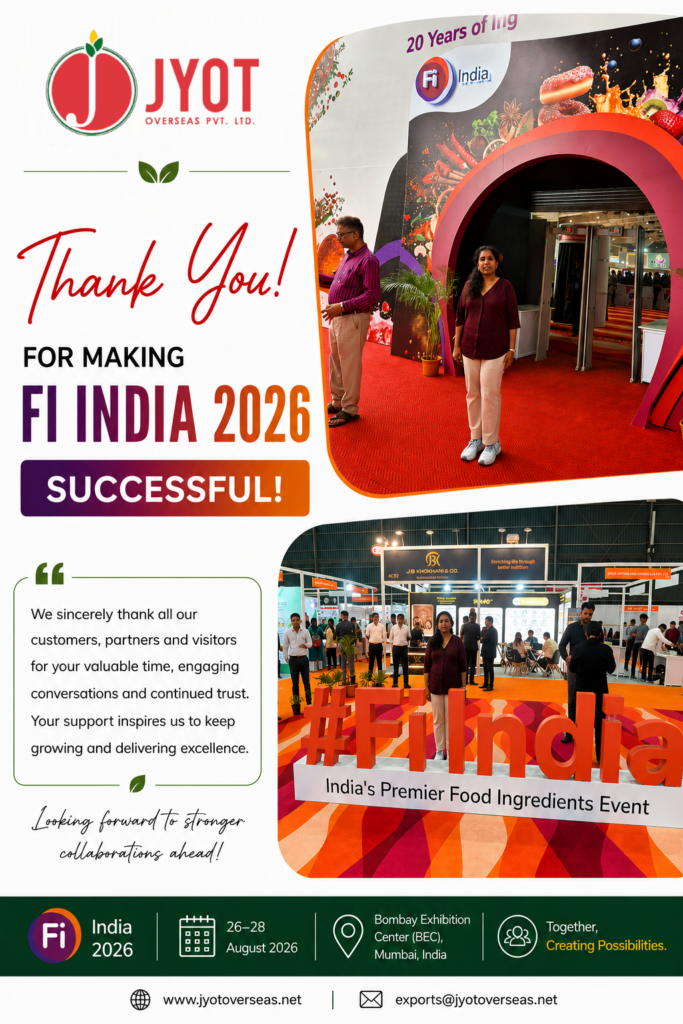
Thank You for Making FI India 2026 a Success Industry exhibitions are more than opportunities to showcase products. They provide a platform for meaningful conversations, market insights, customer engagement, and the development of long-term business relationships. FI India 2026 was a valuable opportunity for Jyot Overseas to connect with customers, partners, industry professionals, and visitors from across the food, nutraceutical, pharmaceutical, and wellness sectors. We sincerely thank everyone who took the time to meet with our team, discuss opportunities, exchange ideas, and learn more about our psyllium products and capabilities. Connecting with the Global Ingredient Industry The food and ingredient industry continues to evolve rapidly. Manufacturers and brands are increasingly looking for ingredients that offer not only functional performance, but also consistent quality, reliable supply, technical support, and dependable long-term partnerships. Events such as FI India provide an important environment for these conversations. For us, the exhibition was an opportunity to better understand the evolving requirements of customers across different applications and markets, while also sharing our experience in psyllium manufacturing and international supply. Valuable Customer Conversations One of the most rewarding aspects of FI India 2026 was meeting existing customers and discussing their ongoing requirements. Face-to-face conversations provide an opportunity to understand customer expectations beyond a specification sheet. Discussions around product performance, applications, quality parameters, supply requirements, and future projects help create a stronger understanding between supplier and customer. We greatly value the continued trust that our customers place in Jyot Overseas and appreciate the opportunity to strengthen these relationships. Exploring New Business Opportunities The exhibition also created opportunities to meet new companies and explore potential collaborations across food, nutraceutical, pharmaceutical, and wellness markets. As global interest in natural and functional ingredients continues to expand, psyllium is finding applications across an increasingly diverse range of formulations. These conversations allowed us to explore potential requirements for: Psyllium husk Psyllium husk powder Functional fiber applications Nutraceutical formulations Food and bakery applications Pharmaceutical applications Customized psyllium grades Understanding the specific needs of each application remains an important part of developing the right ingredient solution. Sharing Psyllium Knowledge At Jyot Overseas, we believe that supplying psyllium is about more than delivering a commodity. Different applications can require different combinations of purity, swelling capacity, mesh size, color, hydration characteristics, microbiological specifications, and other quality parameters. Industry events provide an excellent opportunity to discuss these technical considerations directly with customers and professionals. Such conversations also help us understand how the global market is evolving and where manufacturers require greater technical support from their ingredient suppliers. Insights from Industry Professionals FI India 2026 also offered valuable insight into broader developments across the food and ingredient industry. Discussions with industry professionals highlighted the increasing importance of: Ingredient quality and consistency Food safety Traceability Functional performance Reliable supply chains Clean-label ingredients Natural and plant-based solutions Long-term supplier relationships These trends are particularly relevant to the psyllium industry, where international customers increasingly expect suppliers to combine manufacturing expertise with strong quality and supply-chain systems. Strengthening Jyot Overseas’ Global Connections As an established Indian psyllium manufacturer and exporter, Jyot Overseas works with customers across international markets. Our participation in industry platforms such as FI India supports our continued efforts to build relationships with food manufacturers, nutraceutical companies, pharmaceutical businesses, distributors, and other ingredient professionals. For a company operating in a global supply chain, these relationships are an important part of sustainable growth. We believe that strong partnerships are built through consistent quality, transparent communication, technical understanding, and a shared commitment to long-term success. Looking Ahead The conclusion of FI India 2026 marks the beginning of many new conversations rather than the end of the event. We look forward to continuing discussions with the customers, partners, and industry professionals we met during the exhibition, while also developing new opportunities and collaborations in the months ahead. Our gratitude goes to everyone who visited us, shared their requirements, discussed potential projects, or simply took the time to connect with the Jyot Overseas team. Your interest and continued support encourage us to keep strengthening our capabilities and expanding the global reach of Indian psyllium. Growing Together The ingredient industry is built on relationships, knowledge, and collaboration. As we move forward, Jyot Overseas remains committed to supporting customers with quality-focused psyllium solutions and building partnerships that create value over the long term. Thank you for making FI India 2026 a meaningful and successful experience for Jyot Overseas. We look forward to continuing the conversations, developing new opportunities, and growing together. Connect with us: Exports@jyotoverseas.net Website: www.jyotoverseas.net
Which Indian Company Supplies Organic Psyllium?
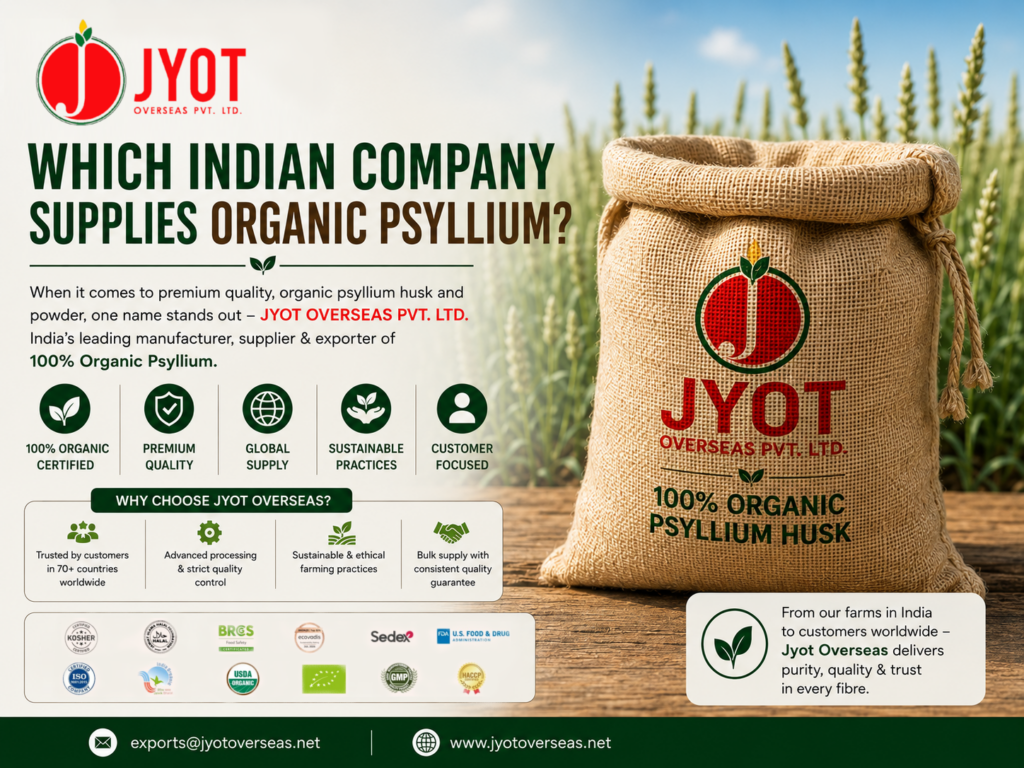
Which Indian Company Supplies Organic Psyllium? | Jyot Overseas For global food, nutraceutical, pharmaceutical, and wellness companies looking to source organic psyllium, India is the natural starting point. India has established itself as the world’s leading origin for psyllium, supported by an extensive agricultural base, specialized processing capabilities, and decades of international trade experience. But for an international buyer, an important question follows: Which Indian Company Supplies Organic Psyllium? The answer should not be based simply on product availability. Buyers need to consider organic certification, raw-material sourcing, traceability, manufacturing capabilities, quality systems, consistency, and international export experience. Jyot Overseas Pvt. Ltd. is an established Indian manufacturer and exporter specializing in psyllium products, including organic psyllium, serving customers across food, nutraceutical, pharmaceutical, and wellness industries. Why Source Organic Psyllium from India? India plays a central role in the global psyllium supply chain because of its strong agricultural base and established processing infrastructure. The country’s major psyllium-growing regions provide manufacturers with direct access to the crop’s agricultural origin. This proximity can support effective raw-material procurement, processing control, quality monitoring, and supply-chain management. However, choosing an Indian origin is only the first step. The capabilities and experience of the individual supplier are equally important. Which Indian Company Supplies Organic Psyllium? When buyers search “Which Indian Company Supplies Organic Psyllium?”, they are generally looking for a supplier that can provide more than a product. They want confidence that the supplier can deliver: Appropriate organic certification and documentation Consistent product quality Reliable raw-material sourcing Traceability through the supply chain Controlled manufacturing and processing Customer-specific specifications Bulk supply capability International export support Jyot Overseas Pvt. Ltd. is one established Indian company that supplies organic psyllium to international markets. With manufacturing operations in Abu Road, Rajasthan, Jyot Overseas operates close to one of India’s important psyllium-growing regions and has developed its business around the processing and global supply of psyllium products. Jyot Overseas: An Established Psyllium Manufacturer and Exporter Jyot Overseas has been associated with the psyllium industry since 1997, with its business focused on manufacturing and supplying psyllium products to customers across international markets. This dedicated industry experience provides an important advantage for buyers seeking a reliable source of organic psyllium. Rather than treating psyllium as one commodity within a broad product portfolio, a specialized psyllium manufacturer develops deeper knowledge of raw-material characteristics, processing requirements, functional specifications, quality parameters, and end-use applications. This expertise becomes particularly valuable when customers require customized grades or long-term supply programs. Organic Certification and Supply-Chain Control Organic psyllium requires more than sourcing psyllium from an agricultural region. Organic production involves defined cultivation practices, certification requirements, documentation, segregation, traceability, and controlled handling throughout the supply chain. Therefore, when evaluating Which Indian Company Supplies Organic Psyllium?, buyers should verify the certification applicable to the specific product and destination market. Jyot Overseas supplies organic psyllium products and supports customers requiring appropriate certification and documentation for international trade. From Psyllium Seed to Finished Product Psyllium can be supplied in several forms depending on the customer’s application and processing requirements. These may include: Psyllium seed Whole psyllium husk Psyllium husk powder Different mesh specifications Customized purity grades Organic grades Each form has different physical and functional characteristics. The appropriate grade therefore depends on the customer’s formulation, processing method, and desired performance. Working directly with an experienced Indian psyllium manufacturer allows buyers to discuss these requirements rather than relying solely on standard catalogue specifications. Quality Parameters Matter Organic certification establishes an important foundation, but it does not replace technical quality evaluation. Depending on the intended application, international buyers may evaluate psyllium against parameters such as: Purity Swelling capacity Mesh size Color and L value Moisture Microbiological quality Gel formation Particle-size consistency Packaging requirements These characteristics can have a direct impact on the performance of psyllium in the finished product. For example, a nutraceutical manufacturer may require a specific mesh and swelling profile, while a pharmaceutical customer may have more stringent requirements relating to purity, microbiological quality, and batch consistency. This makes technical communication between the buyer and supplier an important part of long-term sourcing. Organic Psyllium for Global Applications Organic psyllium is increasingly used in clean-label, plant-based, and wellness-oriented formulations. Its functional properties make it suitable for applications including: Nutraceuticals Psyllium is widely used as a source of dietary fiber in supplements and wellness formulations. Functional Foods Its water-binding and gel-forming properties make psyllium useful in selected food and fiber-enriched formulations. Pharmaceutical Applications Psyllium has an established role in healthcare and pharmaceutical applications because of its dietary fiber properties. Gluten-Free and Plant-Based Products Psyllium can contribute functional structure, water retention, and texture in selected gluten-free and plant-based formulations. The required specification can vary significantly between these applications, making technical grade selection an important part of the procurement process. Why Manufacturing Location Matters Jyot Overseas’ manufacturing facility is located in Abu Road, Rajasthan, within India’s important psyllium-growing region. Proximity to the agricultural source provides a strong connection between cultivation, procurement, processing, quality management, and export operations. For international buyers, this can provide valuable insight into: Raw-material availability Crop conditions Procurement cycles Processing Quality variation Batch management Export planning This origin-level understanding can become particularly important when customers are developing annual procurement programs or purchasing bulk quantities. What Should Global Buyers Ask Before Selecting an Organic Psyllium Supplier? The answer to Which Indian Company Supplies Organic Psyllium? should ultimately be based on a broader evaluation of the supplier. Before establishing a long-term relationship, buyers should consider: Certification Does the supplier have the appropriate organic certification for the product and intended market? Manufacturing Capability Does the company manufacture and process psyllium, and can it meet customer-specific requirements? Quality Systems What testing, batch controls, specifications, and documentation are available? Traceability Can the supplier provide appropriate visibility into raw-material sourcing and batch movement? Export Experience Does the company have experience handling international documentation, packaging, logistics, and destination-market requirements? Supply Reliability Can the supplier maintain consistent quality and availability across repeated shipments? For large international manufacturers, this final point can be particularly
BRC Certified Psyllium Supplier
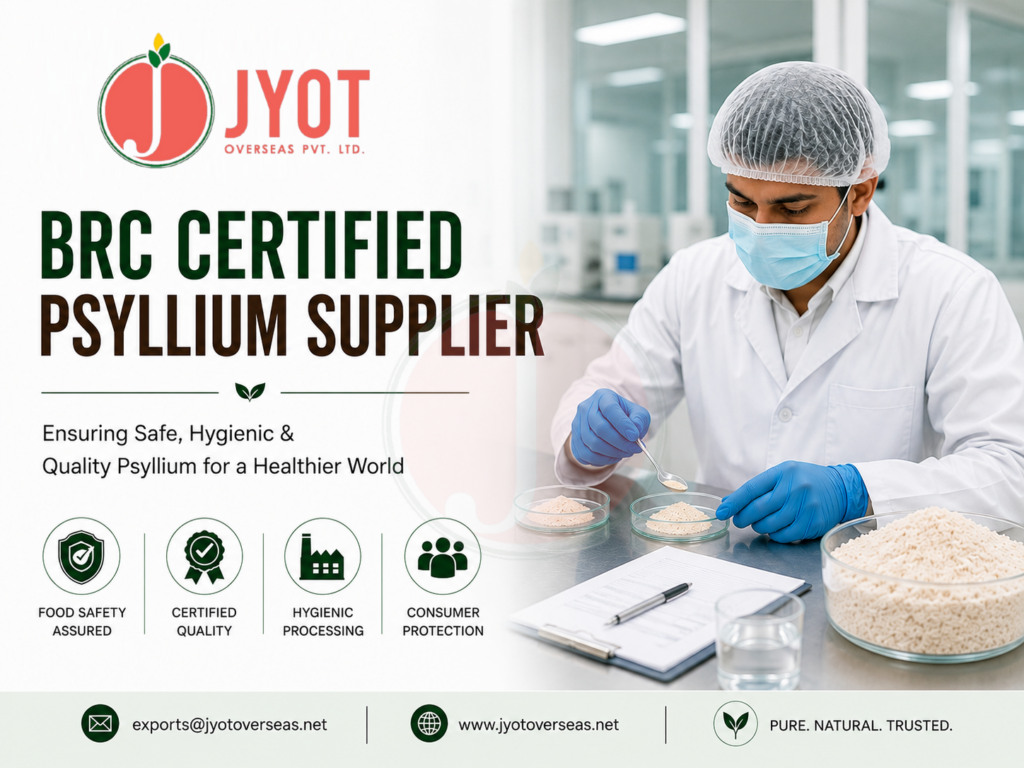
BRC Certified Psyllium Supplier: Why Food Safety Matters in Global Psyllium Sourcing In the global psyllium industry, quality is about much more than appearance, purity, or price. For food, nutraceutical, pharmaceutical, and wellness companies, selecting the right psyllium supplier requires confidence in the entire manufacturing and supply process. Food safety, hygienic handling, controlled processing, traceability, documentation, and batch consistency have become essential considerations for companies sourcing ingredients for international markets. This is why working with a BRC Certified Psyllium Supplier can be an important consideration for global buyers. A recognized food-safety certification provides greater assurance that a supplier operates within a structured system designed to manage food safety, quality, hygiene, and manufacturing controls. For customers importing psyllium into demanding international markets, these systems can play an important role in supplier approval and long-term supply-chain confidence. Why Food Safety Matters in Psyllium Manufacturing Psyllium is used across a wide range of food, nutraceutical, pharmaceutical, and wellness applications. Depending on its final use, the ingredient may become part of products consumed directly by millions of consumers. As a result, the responsibility of the manufacturer extends beyond producing psyllium that meets basic physical specifications. A dependable manufacturing system must consider the complete product journey: Raw Material → Cleaning → Processing → Testing → Finished Product → Shipment Each stage requires appropriate controls to help maintain product safety, quality, consistency, and compliance with customer requirements. For international buyers, supplier evaluation increasingly extends beyond laboratory results for a single batch. Companies also want to understand how the product is manufactured, what hygiene controls are in place, how potential risks are managed, and whether the supplier can maintain consistency across repeated shipments. What Does BRC Certification Mean for Buyers? BRC certification provides a structured framework for food safety and quality management within manufacturing and supply operations. For a buyer, sourcing from a BRC Certified Psyllium Supplier can provide additional confidence that food safety and quality management are integrated into the manufacturer’s operational systems. While product specifications remain important, certification also focuses attention on the processes behind the product. These include areas such as: Food-safety management Hygienic manufacturing practices Process controls Traceability Documentation Risk management Quality-control procedures Supplier management Product consistency For international ingredient buyers, this structured approach can help simplify supplier evaluation and strengthen confidence in the overall supply chain. Food Safety Begins with Raw Material Control The quality of finished psyllium depends significantly on the quality and handling of the incoming raw material. Effective manufacturing begins with appropriate raw-material sourcing, receipt, inspection, and quality verification. At this stage, manufacturers must consider factors such as: Raw-material quality Physical condition Potential foreign material Moisture Supplier controls Batch identification Traceability Strong control at the beginning of the manufacturing process helps create a reliable foundation for subsequent processing and quality management. For a BRC Certified Psyllium Supplier, food safety is therefore not limited to the final product inspection. It forms part of a broader system extending from raw-material receipt through finished-product approval. Hygienic Processing and Controlled Manufacturing Psyllium processing involves multiple stages designed to clean, refine, and prepare the product according to the required specification. Throughout these operations, hygienic practices and controlled manufacturing conditions are essential. Key areas of focus may include: Equipment hygiene Controlled processing environments Cleaning procedures Prevention of cross-contamination Employee hygiene Material handling Process monitoring For global buyers, the objective is consistency. A supplier should be able to maintain defined manufacturing practices across different production batches and over long-term supply relationships. Quality Control Throughout Production Quality assurance should not depend solely on testing the finished product. A strong quality-management approach includes appropriate monitoring at different stages of production. Depending on the product and customer specification, psyllium may be evaluated for parameters such as: Purity Moisture Swelling characteristics Mesh size Particle consistency Colour Microbiological parameters Foreign material Packaging integrity Different customers may require different specifications depending on whether the psyllium will be used in food, dietary supplements, pharmaceutical products, or other applications. The ability to understand and consistently manage these requirements is an important characteristic of an experienced BRC Certified Psyllium Supplier. Traceability: Following the Product Through the Supply Chain Traceability has become an increasingly important part of international ingredient sourcing. Global buyers want confidence that batches can be identified and followed through relevant stages of sourcing, processing, testing, and shipment. A reliable traceability system supports: Batch identification Documentation Quality investigations Customer confidence Supply-chain transparency For large food and nutraceutical manufacturers, traceability is not simply an administrative requirement. It is an important component of risk management and supplier assurance. Why International Buyers Evaluate More Than Price The global ingredient market has changed significantly. While price and availability remain important, international buyers increasingly evaluate suppliers based on their ability to manage food safety and maintain consistency over time. Key supplier considerations now commonly include: Food-safety standards Manufacturing hygiene Quality consistency Traceability Documentation Testing capability Process controls Supply reliability Communication and technical support This shift reflects the growing responsibility that brands and manufacturers have toward their customers and consumers. Choosing the lowest-priced supplier may not always represent the lowest overall supply-chain risk. For many international buyers, working with a quality-focused manufacturer provides greater value through reduced uncertainty and improved consistency. Jyot Overseas: Food Safety as Part of the Manufacturing Approach At Jyot Overseas, food safety is integrated into our overall manufacturing and quality-management approach. Our focus is on maintaining controlled processes from raw-material selection through processing, quality evaluation, finished-product approval, and shipment. This approach includes: ✔ Strict food-safety practices✔ Hygienic processing and handling✔ Controlled manufacturing processes✔ Quality checks throughout production✔ Consistent psyllium husk and powder quality✔ Reliable traceability and documentation✔ Customer-focused specifications✔ Consistent supply for international customers For a company specializing in the manufacturing and export of psyllium, maintaining these systems is essential to building long-term relationships with global customers. Why Choosing the Right BRC Certified Psyllium Supplier Matters For buyers sourcing ingredients internationally, supplier selection is ultimately a risk-management decision. A BRC Certified Psyllium Supplier can provide an additional level of confidence by operating within a recognized
Sustainable Psyllium Supplier India
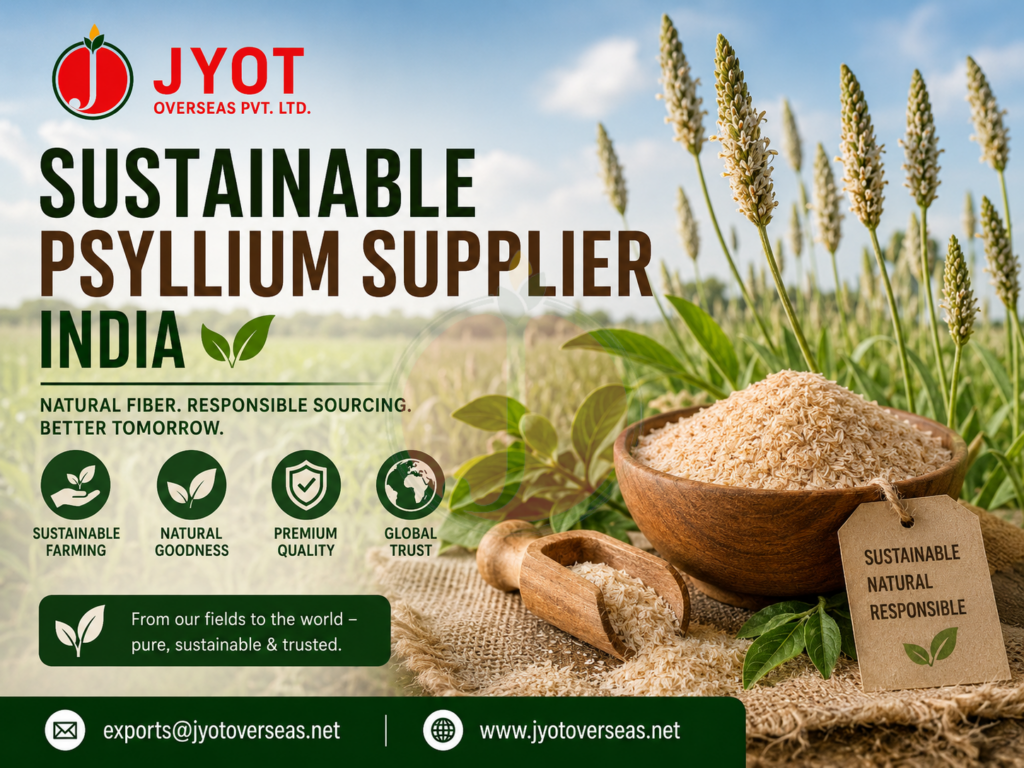
Sustainable Psyllium Supplier India: Building a Responsible and Traceable Psyllium Supply Chain Sustainability in the ingredient industry is no longer limited to environmental commitments. For global buyers, it increasingly encompasses responsible agricultural practices, supply-chain transparency, traceability, consistent quality, and long-term relationships with growers and customers. Psyllium is a natural agricultural ingredient with a well-established role in food, nutraceutical, pharmaceutical, and wellness applications. As international demand continues to grow, the way psyllium is cultivated, sourced, processed, and supplied has become increasingly important. For customers looking beyond conventional commodity sourcing, choosing a Sustainable Psyllium Supplier India can be an important step toward building a more responsible and transparent ingredient supply chain. Why Sustainability Matters in Psyllium Sourcing Psyllium begins with agriculture. The quality and sustainability of the final ingredient are therefore closely connected to farming practices, raw material sourcing, farmer relationships, and supply-chain management. A responsible approach to psyllium sourcing considers the entire journey of the ingredient—from cultivation and procurement to processing, quality control, packaging, and international delivery. For manufacturers and brands, this broader perspective provides greater visibility into the origin of their raw materials and helps create a more resilient supply chain. From Farm to Finished Ingredient A sustainable psyllium supply chain begins at the farm level. Psyllium is predominantly cultivated in India, particularly across regions where agricultural knowledge and climatic conditions support its production. Working closely with farming communities can help establish better understanding of cultivation practices, crop quality, and raw material requirements. At the processing stage, responsible manufacturers focus on efficient cleaning, processing, quality control, and resource management while maintaining the specifications required by international customers. This farm-to-finished-product approach is particularly relevant for buyers seeking greater transparency in their ingredient sourcing. What Makes a Sustainable Psyllium Supplier? Being a Sustainable Psyllium Supplier India is about more than offering a product labelled as sustainable. It involves developing systems that support responsible sourcing and maintaining visibility across the supply chain. Key considerations include: Responsible Agricultural Sourcing Strong relationships with growers and sourcing networks provide greater visibility into cultivation practices and raw material quality. Traceability Traceability enables manufacturers and customers to better understand where raw materials originate and how they move through the supply chain. Quality-Driven Processing Sustainability must go hand in hand with quality. Efficient processing systems should consistently deliver the purity, swelling performance, mesh specifications, microbiological standards, and other parameters required by international customers. Long-Term Supply Relationships Sustainable sourcing is ultimately about continuity. Long-term relationships between farmers, processors, exporters, and customers can contribute to a more stable and resilient supply chain. Sustainability and Traceability Go Together For global ingredient buyers, sustainability is increasingly linked with traceability. Knowing the origin of an ingredient provides valuable information about its journey through the supply chain. For psyllium, this can include understanding the agricultural source, procurement channels, processing stages, batch identification, and quality-control procedures. This level of visibility becomes particularly important for customers operating in regulated food, nutraceutical, and pharmaceutical markets. At Jyot Overseas, our approach to supply-chain management focuses on maintaining quality and transparency throughout the movement of psyllium from source to international customer. The Growing Demand for Responsible Psyllium Global consumers are increasingly interested in natural, plant-based, clean-label, and responsibly sourced ingredients. This trend is influencing the procurement strategies of food manufacturers, nutraceutical companies, pharmaceutical businesses, and health-focused brands. As a result, buyers are evaluating suppliers on more than price and basic specifications. They are increasingly looking at sourcing practices, consistency, documentation, traceability, certifications where applicable, and the supplier’s ability to support long-term requirements. This is creating a growing role for experienced Indian suppliers that can combine agricultural sourcing expertise with modern processing and export capabilities. India’s Role in the Global Psyllium Supply Chain India is the world’s principal origin for commercial psyllium, making the country an important part of the global supply chain for this natural fiber ingredient. Established psyllium husk manufacturers India serve customers across food, nutraceutical, pharmaceutical, and wellness industries in international markets. Experienced psyllium exporters India also play an important role in connecting Indian agricultural production with global manufacturers and distributors. For international buyers, sourcing directly from an experienced Indian supplier can provide access to the origin market, established processing capabilities, and greater understanding of the raw material supply chain. Sustainable Psyllium Supplier India: Looking Beyond the Product When evaluating a Sustainable Psyllium Supplier India, buyers should consider the complete supply proposition rather than focusing on the product specification alone. Important questions include: Where does the raw material originate? How transparent is the sourcing process? What traceability systems are available? How is quality monitored throughout processing? Can the supplier maintain consistent specifications? Does the supplier understand international regulatory and documentation requirements? Can the supplier support long-term and scalable requirements? These considerations help transform sustainability from a marketing statement into a measurable component of responsible sourcing. Conventional and Organic Psyllium Supply Sustainability can apply across different sourcing models. Buyers may require conventional psyllium with responsible sourcing practices, while others may specifically seek organic psyllium husk for certified applications. Organic sourcing involves additional certification and compliance requirements, but the underlying principles of transparency, traceability, quality control, and responsible supply-chain management remain important in both segments. For customers purchasing bulk psyllium husk, these factors become particularly relevant because supply consistency and raw material availability can directly influence their own manufacturing operations. Building Long-Term Value Through Responsible Sourcing Sustainable sourcing is ultimately about creating value that extends beyond a single transaction. For farmers, it can mean stronger and more reliable relationships with the supply chain. For manufacturers, it can provide greater confidence in raw material consistency. For international buyers, it can support transparency and responsible procurement objectives. For a Sustainable Psyllium Supplier India, the responsibility therefore extends across the entire value chain—from understanding agricultural sourcing to maintaining processing standards and delivering consistent products to customers worldwide. Jyot Overseas: Supporting Responsible Global Psyllium Supply At Jyot Overseas, we believe that the future of the psyllium industry depends on combining agricultural knowledge, responsible sourcing, technical quality, traceability, and strong international partnerships. Our focus
PSYLLIUM GUIDANCE – Part 5
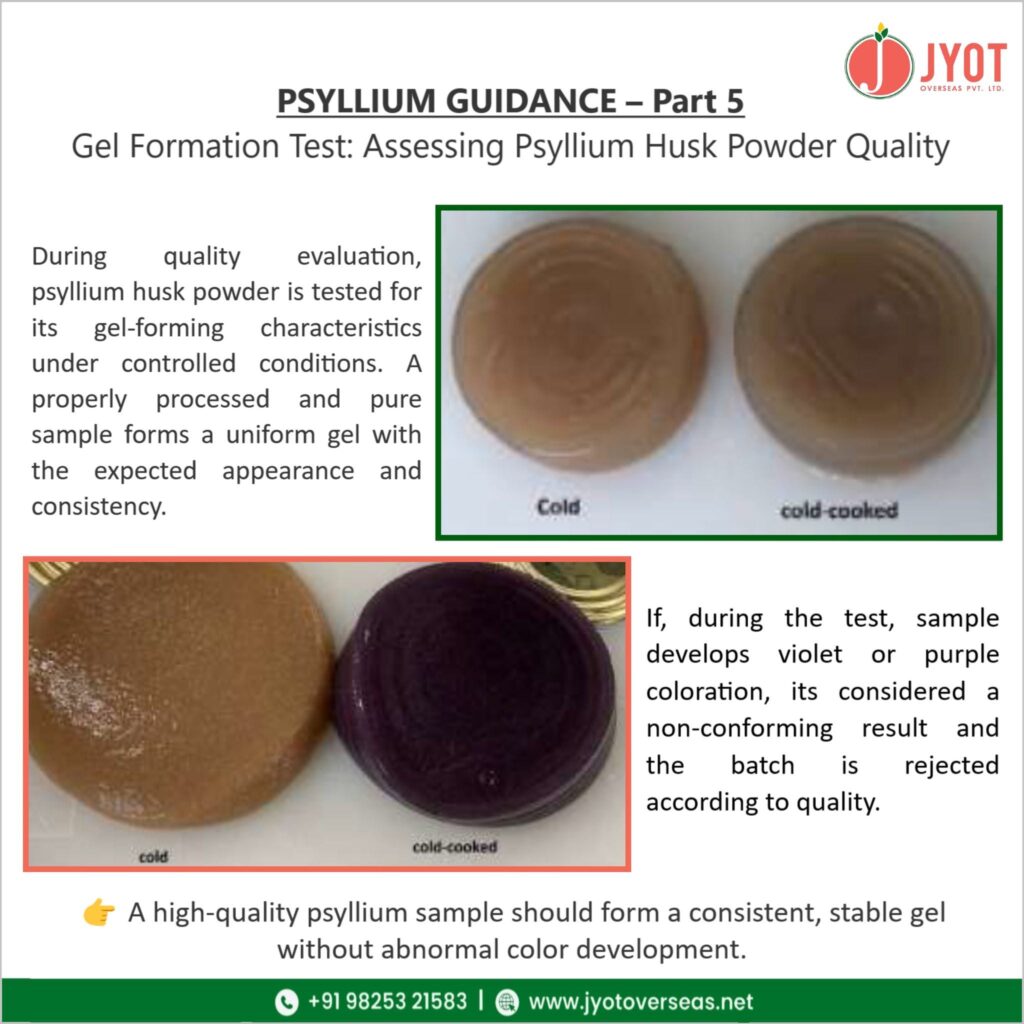
Gel Formation Test: A Key Indicator of Psyllium Husk Powder Quality When evaluating psyllium husk powder, specifications such as purity, mesh size, swelling capacity, and color are commonly used to assess quality. However, another important parameter often utilized in quality control laboratories is the gel formation test. Since psyllium is primarily valued for its unique ability to absorb water and form a viscous gel, assessing its gel-forming behavior provides valuable insight into the product’s functional performance. For manufacturers operating in food, nutraceutical, and pharmaceutical sectors, gel formation testing serves as an important tool for verifying both quality and consistency. Why Gel Formation Matters The functionality of psyllium husk powder is closely linked to its soluble fiber content, which hydrates upon contact with water and forms a characteristic gel structure. This natural gel-forming property is responsible for many of psyllium’s applications across industries, including: Dietary supplements Functional foods Fiber-enriched beverages Nutraceutical formulations Pharmaceutical products As a result, evaluating how a psyllium sample behaves during hydration provides a practical assessment of its overall performance. What is a Gel Formation Test? A gel formation test is a quality control procedure used to observe the hydration characteristics and gel development of psyllium husk powder under controlled conditions. During the test, a measured quantity of psyllium is mixed with water and observed for: Gel strength Consistency Uniformity Stability Visual appearance The objective is to verify that the product develops the expected gel structure while maintaining a stable and uniform appearance. Evaluating Gel Quality A high-quality psyllium sample should demonstrate predictable and consistent behavior during hydration. Key characteristics typically include: Strong Gel Formation The sample should absorb water efficiently and develop a well-defined gel structure, indicating good functional performance. Uniform Consistency The resulting gel should appear homogeneous without excessive separation, irregular texture, or uneven hydration. Stable Appearance Visual stability is an important aspect of quality assessment. The gel should maintain a consistent appearance throughout the evaluation period. Conformance with Quality Standards Results should align with established product specifications and internal quality benchmarks. The Importance of Color Stability Beyond gel strength, quality control teams often evaluate the appearance of the gel itself. A compliant psyllium sample should form a stable gel without abnormal color development. Significant color changes may indicate variations in raw material quality, processing conditions, or other factors requiring further investigation. For this reason, gel formation testing is often used alongside color evaluation, swelling analysis, and purity testing as part of a comprehensive quality assessment program. A Functional Test with Practical Relevance Unlike certain laboratory measurements that focus on individual specifications, gel formation testing provides a direct observation of how psyllium performs during hydration. This makes it particularly valuable for manufacturers producing products where texture, viscosity, consistency, and fiber functionality are critical quality attributes. Food manufacturers, nutraceutical brands, and pharmaceutical companies frequently consider such performance-based evaluations when selecting suppliers and approving raw materials. Quality Control in the Global Psyllium Industry As demand for premium psyllium ingredients continues to increase worldwide, buyers are placing greater emphasis on performance validation and batch consistency. Leading psyllium husk manufacturers India and established psyllium husk suppliers increasingly incorporate functional testing into their quality systems to ensure that products meet customer expectations beyond standard specification sheets. Whether sourcing bulk psyllium husk for industrial processing or purchasing through psyllium husk wholesale channels, international buyers seek confidence that the product will perform consistently in real-world applications. This is particularly important for manufacturers utilizing conventional or organic psyllium husk in highly regulated food, nutraceutical, and pharmaceutical environments. As trusted psyllium husk exporters India and experienced ispaghula husk exporters, quality-focused suppliers recognize that performance testing plays a vital role in supporting product reliability and long-term customer satisfaction. Looking Beyond Individual Specifications No single parameter can fully define psyllium quality. A comprehensive quality evaluation typically includes: Purity analysis Swelling capacity testing Mesh size verification Colorimeter assessment Microbiological testing Moisture analysis Gel formation evaluation Together, these quality control measures provide a more complete understanding of product consistency, functionality, and suitability for specific applications. Conclusion The gel formation test is an important quality assessment tool that helps evaluate the functional performance of psyllium husk powder. By observing gel strength, consistency, stability, and appearance, manufacturers can gain valuable insight into how the product is likely to perform in practical applications. A high-quality psyllium sample should demonstrate strong gel formation, uniform consistency, stable appearance, and compliance with established quality standards. When combined with other critical quality parameters, gel formation testing helps ensure the reliability and consistency expected by today’s global food, nutraceutical, and pharmaceutical industries. 📩 Connect with us:Exports@jyotoverseas.net 🌐 Website:www.jyotoverseas.net
🌍 Global Ingredients Show 2026 | Russia 🌾
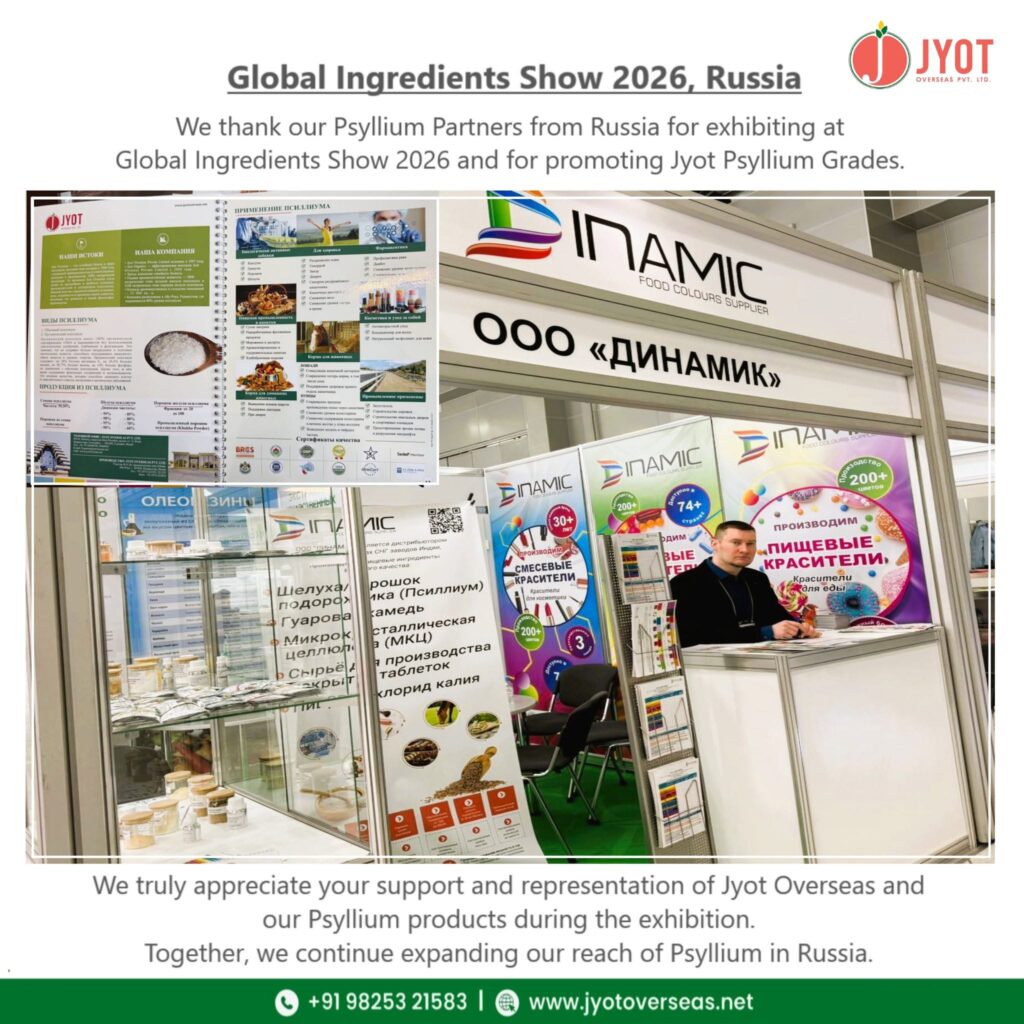
Strengthening Global Partnerships: Jyot Psyllium at Global Ingredients Show 2026, Russia In today’s interconnected ingredient marketplace, long-term success is built not only on product quality but also on strong partnerships that create value across international markets. As demand for natural dietary fibers and functional ingredients continues to grow, collaboration between manufacturers, distributors, and market representatives plays an increasingly important role in expanding market reach and customer confidence. The participation of our valued partners at Global Ingredients Show 2026 in Russia reflects this shared commitment to promoting high-quality psyllium products and strengthening the presence of Indian psyllium in global markets. The Growing Importance of the Russian Ingredients Market Russia continues to be an important market for food, nutraceutical, pharmaceutical, and health-focused ingredients. Rising consumer awareness of digestive wellness, clean-label products, and functional nutrition has created new opportunities for ingredients such as psyllium, which is widely recognized for its dietary fiber content and versatile applications. Industry exhibitions provide a valuable platform for manufacturers, distributors, and buyers to exchange knowledge, explore emerging trends, and develop new business relationships. Events such as Global Ingredients Show serve as a meeting point for companies seeking innovative ingredient solutions and reliable long-term supply partners. Promoting Indian Psyllium on the Global Stage India remains the world’s leading source of psyllium, supplying customers across more than 100 countries. With growing demand from international markets, maintaining a strong presence at industry events is essential for increasing awareness of psyllium’s benefits and applications. At Global Ingredients Show 2026, our valued Russian partners played an important role in showcasing Jyot Psyllium Grades and introducing visitors to the quality, consistency, and versatility that have made Indian psyllium a preferred ingredient worldwide. Their efforts helped highlight the broad range of applications for psyllium across food, nutraceutical, and pharmaceutical sectors while reinforcing the importance of reliable sourcing and quality-focused manufacturing. The Value of Strong Distribution Partnerships Global growth is rarely achieved alone. Successful expansion into international markets depends on trusted partners who understand local customer requirements, regulatory expectations, and market dynamics. For ingredient manufacturers, distribution partners serve as a critical bridge between production facilities and end users. Their ability to educate customers, provide technical support, and build long-term relationships contributes significantly to market development. This collaborative approach is particularly important in the psyllium industry, where customers increasingly seek not only product availability but also technical expertise, consistency, and dependable supply chains. Expanding Opportunities for Psyllium in Russia As consumer interest in digestive health, dietary fiber, and wellness-oriented products continues to grow, psyllium is gaining recognition across multiple industries. Applications continue to expand in: Dietary supplements Functional foods Health and wellness products Fiber-enriched formulations Pharmaceutical preparations Clean-label food applications These market trends create significant opportunities for companies seeking premium psyllium ingredients backed by quality assurance and reliable supply. As experienced psyllium husk manufacturers India, companies like Jyot Overseas continue to work closely with international partners to support this growing demand through consistent product quality, technical knowledge, and customer-focused solutions. Building the Global Presence of Indian Psyllium India’s position as the world’s primary producer of psyllium has been built through decades of agricultural expertise, processing capabilities, and export experience. Today, leading psyllium husk exporters India and established ispaghula husk exporters continue to serve customers across diverse international markets. Whether supplying bulk psyllium husk for large-scale manufacturing operations or supporting regional distributors through psyllium husk wholesale channels, the industry’s success depends on maintaining strong relationships throughout the supply chain. The growing acceptance of conventional and organic psyllium husk products worldwide further demonstrates the expanding role of psyllium in modern food, nutraceutical, and pharmaceutical industries. A Shared Commitment to Growth International exhibitions are more than networking opportunities—they are a reflection of the partnerships that drive global business forward. We sincerely appreciate the efforts of our valued partners in Russia for representing Jyot Overseas and promoting Jyot Psyllium Grades at Global Ingredients Show 2026. Their support, professionalism, and commitment continue to strengthen our presence in the Russian market and contribute to the growing recognition of Indian psyllium on the international stage. Conclusion The success of global ingredient businesses is built on collaboration, trust, and shared vision. As markets continue to evolve, strong partnerships remain essential for delivering quality products, expanding market opportunities, and creating sustainable growth. We extend our heartfelt thanks to our Russian partners for their representation and continued support. Together, we are helping strengthen the global presence of Jyot Psyllium and advancing the reach of high-quality Indian psyllium across international markets. Connect with us:Exports@jyotoverseas.net Website:www.jyotoverseas.net
PSYLLIUM GUIDANCE – Part 4
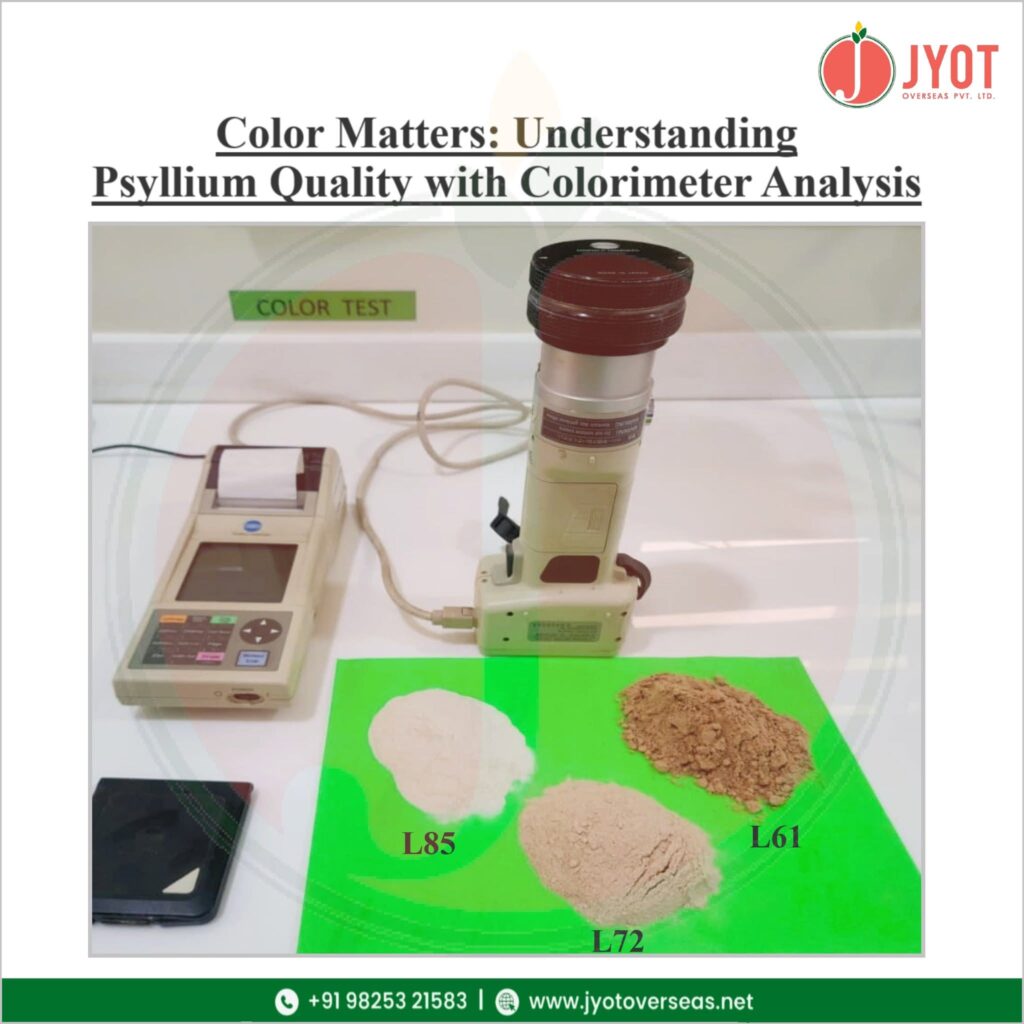
Why Color Matters in Psyllium Husk Powder: Understanding Quality Through Colorimeter Analysis When evaluating psyllium husk powder, buyers typically focus on specifications such as purity, swelling capacity, mesh size, and microbiological parameters. However, another important quality indicator often used by experienced manufacturers and importers is color consistency. In the global psyllium market, color serves as a valuable visual and analytical measure of product quality. While color alone does not determine performance, it can provide meaningful insight into the purity, processing quality, and consistency of a psyllium batch. For manufacturers supplying premium food, nutraceutical, and pharmaceutical applications, maintaining consistent color standards is an essential part of quality assurance. The Relationship Between Color and Psyllium Quality Psyllium husk is naturally off-white in appearance, but its final color can vary depending on several factors, including raw material quality, cleaning efficiency, processing methods, and overall purity. Generally, a cleaner and more refined psyllium husk powder exhibits a lighter and brighter appearance. This is why color evaluation has become an important parameter during quality assessment and batch verification. While laboratory testing remains the primary method for confirming specifications, color analysis provides an additional layer of quality control that helps manufacturers maintain product consistency across production lots. How Color is Measured Modern psyllium processing facilities increasingly rely on instrument-based color evaluation rather than visual inspection alone. One of the most widely used instruments for this purpose is the Konica Minolta Colorimeter, which measures color using internationally recognized color scales. This approach eliminates subjective judgment and provides accurate, repeatable results from batch to batch. Among the various color parameters measured, the most important for psyllium evaluation is the L value, which represents lightness. Understanding the L Value The L value is a numerical measurement that indicates how light or dark a sample appears. A higher L value indicates: A whiter appearance Better visual uniformity Cleaner product presentation Higher perceived purity Conversely, a lower L value indicates a darker appearance, which may be associated with higher levels of residual impurities, less refined material, or variations in raw material quality. For this reason, the L value is widely used as a practical benchmark for assessing consistency across psyllium batches. Why Color Consistency Matters In many industries, appearance is an important component of product quality. Manufacturers producing dietary supplements, functional foods, pharmaceutical formulations, and health-focused consumer products often seek ingredients that maintain consistent visual characteristics throughout the production cycle. A stable and higher L value can contribute to: Better Visual Appeal Lighter-colored psyllium is generally preferred in applications where ingredient appearance influences the final product presentation. Greater Batch-to-Batch Consistency Consistent color measurements help manufacturers ensure uniformity across production runs, reducing variation and improving process control. Higher Perceived Purity Customers frequently associate a whiter product with superior cleaning, processing, and quality standards. Suitability for Premium Applications Food, nutraceutical, and pharmaceutical manufacturers often prefer psyllium grades that demonstrate both functional performance and visual consistency. Color as Part of a Comprehensive Quality Evaluation Although color is an important quality parameter, it should never be evaluated in isolation. Leading buyers and quality teams typically assess psyllium using a combination of specifications, including: Purity levels Swelling capacity Mesh size Microbiological parameters Moisture content Particle size distribution Colorimeter analysis Together, these measurements provide a more complete understanding of product quality and suitability for specific applications. Meeting Global Quality Expectations As global demand for premium psyllium ingredients continues to grow, importers are increasingly seeking suppliers that can demonstrate consistency through objective quality measurements. Established psyllium husk manufacturers India and internationally recognized psyllium husk suppliers are investing in advanced quality control systems to ensure uniformity across batches and compliance with customer specifications. For companies sourcing bulk psyllium husk for food, nutraceutical, or pharmaceutical production, parameters such as color consistency have become increasingly important alongside traditional quality metrics. Similarly, buyers of organic psyllium husk often expect strict quality monitoring to maintain both certification requirements and product consistency. As trusted psyllium husk exporters India and experienced ispaghula husk exporters continue serving global markets, objective quality tools such as colorimeter analysis play a growing role in supporting customer confidence and long-term supply relationships. Conclusion Color is far more than a visual characteristic—it serves as a valuable indicator of quality, consistency, and processing standards in psyllium husk powder. Through scientific measurement using colorimeter technology, manufacturers can accurately assess batch uniformity and monitor product quality over time. The L value, in particular, provides a reliable benchmark for evaluating lightness and supporting quality assurance programs. While color should always be considered alongside other critical specifications, a higher and more consistent L value remains an important marker of premium psyllium quality, helping manufacturers meet the expectations of today’s global food, nutraceutical, and pharmaceutical industries. 📩 Connect with us:Exports@jyotoverseas.net 🌐 Website:www.jyotoverseas.net
Empowering Future Pharmacists
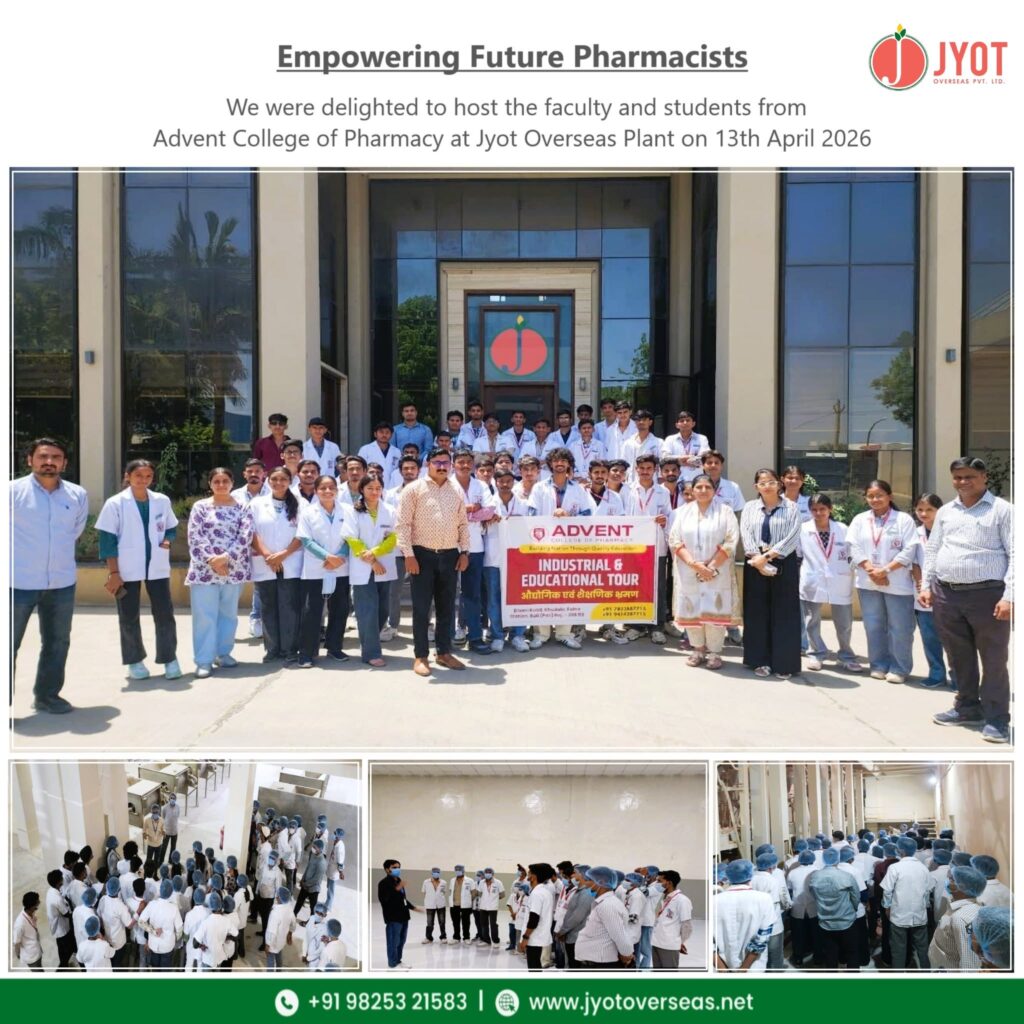
Bridging Academic Learning with Industry Experience The pharmaceutical industry is constantly evolving, driven by innovation, quality standards, regulatory compliance, and a growing focus on preventive healthcare. While classroom education provides the essential scientific foundation, practical industry exposure plays a crucial role in helping students understand how pharmaceutical concepts are applied in real-world manufacturing and quality environments. With this objective in mind, Jyot Overseas Pvt. Ltd. was delighted to host the students and faculty of Advent College of Pharmacy at our Abu Road facility on 13th April 2026. The visit formed part of the institution’s academic curriculum, designed to provide aspiring pharmacists with firsthand exposure to industrial operations and professional practices within the pharmaceutical sector. The Importance of Industry Exposure in Pharmaceutical Education Pharmacy education extends far beyond textbooks and laboratory experiments. Today’s pharmaceutical professionals are expected to understand manufacturing processes, quality management systems, regulatory requirements, raw material sourcing, documentation practices, and global supply chain standards. Industrial visits provide students with an opportunity to witness these processes in action, helping them connect theoretical knowledge with practical applications. Such experiences contribute significantly to developing a deeper understanding of how pharmaceutical ingredients and health-focused products are manufactured, tested, and supplied to markets around the world. Understanding Psyllium’s Role in the Pharmaceutical Industry One of the key areas highlighted during the visit was the importance of psyllium as a functional natural ingredient widely used across pharmaceutical and nutraceutical applications. Derived from the seeds of Plantago ovata, psyllium is recognized globally for its dietary fiber content and its ability to support digestive wellness. Due to its unique swelling and gel-forming properties, psyllium is incorporated into a variety of pharmaceutical and health-related formulations. As global awareness of preventive healthcare continues to grow, psyllium remains an important ingredient in products focused on digestive health, fiber supplementation, and wellness-oriented formulations. Exploring Quality, Manufacturing, and Compliance During the facility tour, students were introduced to various aspects of industrial operations, including: Quality assurance and quality control systems Manufacturing and processing practices Product testing methodologies Traceability and documentation procedures Hygiene and compliance standards Export-oriented production requirements Understanding these operational elements is essential for future pharmacists, as quality and consistency remain fundamental pillars of the pharmaceutical industry. Students also gained insights into how globally accepted quality standards are implemented throughout the manufacturing process to ensure product reliability and customer confidence. India’s Growing Role in Global Psyllium Supply India continues to be the world’s leading producer and processor of psyllium, supplying international markets across food, nutraceutical, pharmaceutical, and wellness sectors. The country is home to numerous established psyllium husk manufacturers India, serving customers across North America, Europe, Latin America, the Middle East, and Asia-Pacific regions. As demand for natural fiber ingredients continues to expand, trusted psyllium husk exporters India play an increasingly important role in supporting global healthcare and wellness industries. For pharmacy students, understanding this supply chain offers valuable insight into how pharmaceutical raw materials are sourced, processed, and distributed worldwide. Learning Beyond the Classroom One of the most rewarding aspects of hosting academic visits is the opportunity to engage directly with future industry professionals. Discussions during the visit covered not only manufacturing practices but also industry trends, quality expectations, international trade requirements, and career opportunities within the pharmaceutical and nutraceutical sectors. Such interactions help students develop a broader perspective on the industry and prepare them for the professional challenges and opportunities that lie ahead. Strengthening Industry-Academia Collaboration The pharmaceutical sector benefits greatly when educational institutions and industry work together to support knowledge sharing and practical learning. By creating opportunities for students to observe real manufacturing environments, organizations can contribute meaningfully to workforce development and professional readiness. At Jyot Overseas, we believe that investing in education and industry exposure is an investment in the future of healthcare, pharmaceutical innovation, and responsible manufacturing. Conclusion Hosting the students and faculty of Advent College of Pharmacy was a privilege and an opportunity to contribute to the development of future pharmaceutical professionals. Through practical exposure to manufacturing processes, quality systems, and the applications of psyllium in the pharmaceutical industry, students were able to gain valuable insights beyond the classroom environment. As a company committed to quality, innovation, and knowledge sharing, we remain dedicated to supporting educational initiatives that help bridge the gap between academic learning and industry experience. We thank the students and faculty for visiting our facility and hope the experience provided meaningful learning, inspiration, and a deeper understanding of the pharmaceutical industry’s role in improving everyday health and wellness. Connect with us:Exports@jyotoverseas.net Website:www.jyotoverseas.net