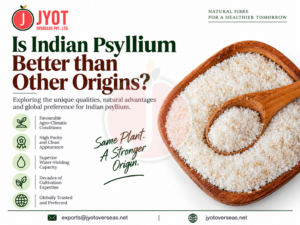
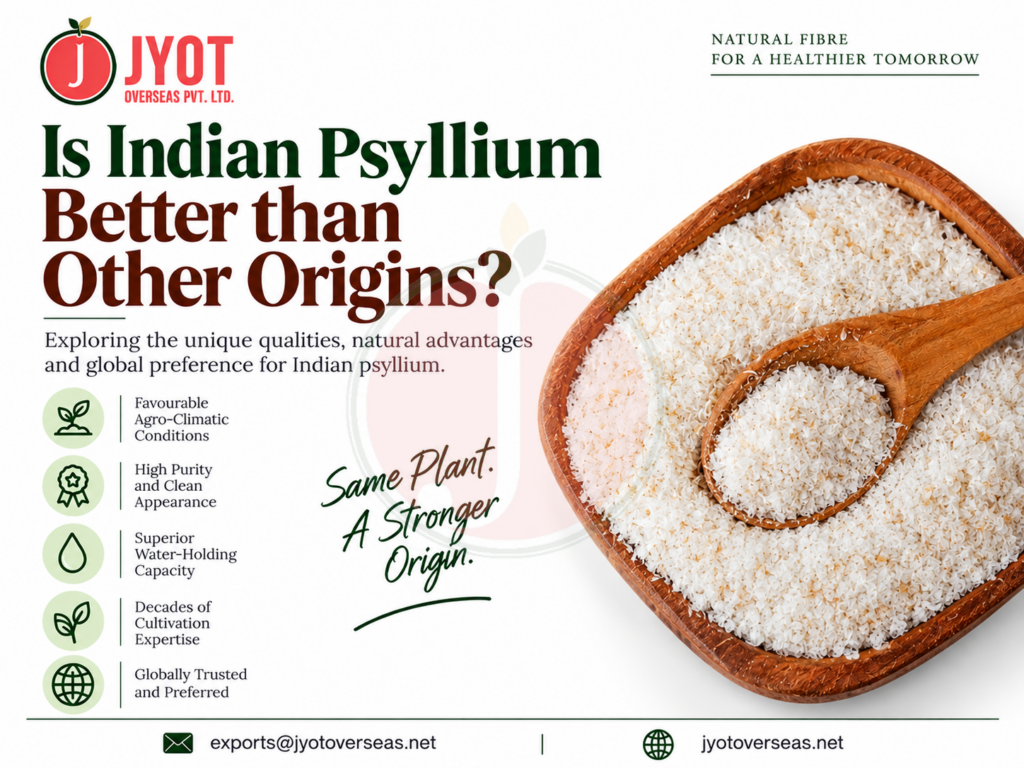
Is Indian Psyllium Better Than Other Origins? A Buyer’s Guide to Quality and Sourcing
In the global psyllium market, one question frequently comes up among ingredient buyers: Is Indian psyllium better than psyllium from other origins?
India is a major source of psyllium, also known as Isabgol, supplying psyllium husk and psyllium husk powder to international food, nutraceutical, pharmaceutical, and wellness industries. Its established cultivation base, processing expertise, and export experience make Indian psyllium an important choice for global ingredient sourcing.
However, the real answer depends on more than geographical origin. Cultivation conditions, raw material selection, processing technology, quality testing, and manufacturing controls all influence the final product.
For international buyers looking for a reliable psyllium manufacturer in India, understanding these factors is essential to making an informed sourcing decision.
Why Is Indian Psyllium Important in the Global Market?
India has a long-established psyllium cultivation and processing industry, supported by agricultural expertise, specialized manufacturing facilities, and an experienced export supply chain.
Several factors contribute to the importance of Indian psyllium in international markets.
1. Established Psyllium Cultivation
Psyllium cultivation has a strong agricultural base in India, particularly in Gujarat and Rajasthan. This established sourcing network supports the availability of psyllium seed for processing into husk, powder, and other product grades.
For bulk buyers, an established cultivation base can be an important consideration when evaluating raw material availability and long-term supply potential.
2. Specialized Processing Expertise
Producing consistent psyllium ingredients requires more than sourcing agricultural raw material. Cleaning, separation, grading, milling, sieving, and quality verification all influence the finished product.
Experienced Indian psyllium manufacturers have developed processing capabilities to supply different grades according to customer specifications and intended applications.
3. A Wide Range of Psyllium Products
Indian suppliers offer different psyllium products for diverse industrial requirements, including:
Psyllium husk in different purity grades
Psyllium husk powder in different mesh sizes
Psyllium seed and seed powder
Conventional and certified organic psyllium, subject to product and certification availability
Specialized grades developed to meet customer specifications
This product range allows international buyers to evaluate suppliers according to their formulation, processing, and regulatory requirements.
4. Experience in International Trade
Global ingredient markets require suppliers to manage product specifications, export documentation, packaging, shipment planning, and customer-specific requirements.
Experienced Indian psyllium exporters understand the importance of coordinating these requirements to support dependable international supply.
Indian Psyllium vs. Other Origins: What Should Buyers Compare?
The question of whether Indian psyllium is better than other origins should be evaluated through measurable product and supplier criteria rather than origin alone.
| Evaluation factor | What buyers should check |
|---|---|
| Purity | Actual purity percentage and test method |
| Swelling performance | Swelling value under a defined testing method |
| Particle size | Mesh size and particle-size distribution |
| Colour | Agreed colour specifications and measurement method |
| Microbiological quality | Results against applicable specifications |
| Contaminant control | Relevant pesticide residues, heavy metals, and other risk-based tests |
| Processing standards | Cleaning, milling, segregation, and process controls |
| Traceability | Batch identification and raw material records |
| Documentation | Specifications, COA, certificates, and applicable regulatory documents |
| Supply reliability | Production capacity, lead time, and consistency across shipments |
These parameters help buyers make a more meaningful comparison between suppliers and origins.
The key point: Indian origin can offer established sourcing and processing advantages, but the suitability of any psyllium ingredient must be confirmed through product specifications, testing, and supplier evaluation.
Why Quality-Controlled Processing Matters More Than Origin Alone
Psyllium is a functional ingredient, and its performance can affect the final application. Two products from the same country may perform differently because of variations in raw material, purity, particle size, processing, and testing methods.
A reliable quality-control process typically covers:
Cultivation → Raw Material Selection → Cleaning → Processing → Testing → Finished Product Approval → Documentation → Shipment
For example, a food manufacturer may prioritize purity, swelling performance, microbiological quality, and particle size. A pharmaceutical or nutraceutical buyer may have additional requirements relating to contaminants, documentation, traceability, and regulatory compliance.
Therefore, selecting the right psyllium husk supplier requires a clear understanding of the product’s intended use and the specifications that matter most to its performance.
Jyot Overseas: An Exclusive Psyllium Manufacturer and Exporter
At Jyot Overseas, we focus on supplying psyllium ingredients with defined specifications for international customers across food, nutraceutical, pharmaceutical, and wellness applications.
As an Indian psyllium manufacturer and exporter, our product portfolio includes psyllium husk and psyllium husk powder, with grades and specifications considered according to customer requirements and product availability.
Our approach emphasizes:
Quality-focused processing and product consistency
Defined product specifications and quality verification
Appropriate testing and batch documentation
Traceability and responsible sourcing initiatives
Customer-specific product and export requirements
Reliable coordination for international shipments
We recognize that global buyers need more than a supplier based in a particular country. They need a manufacturing partner who understands their quality expectations, intended applications, documentation requirements, and long-term sourcing objectives.
That is why our focus extends beyond Indian origin to the controls and processes that help deliver consistent psyllium ingredients.
How to Choose the Right Psyllium Supplier in India
When evaluating a psyllium supplier, international buyers should consider the following questions:
Can the supplier meet the required purity, mesh size, and swelling specifications?
Are product quality and testing methods clearly defined?
Does the manufacturer operate suitable food safety and quality systems?
Can the supplier provide relevant certificates and export documentation?
Are batch traceability and quality records available?
Can the supplier support the required volumes, packaging, and shipment schedules?
Is the supplier equipped to support long-term business requirements?
Comparing suppliers against these criteria provides a stronger basis for procurement decisions than choosing by country of origin or price alone.
For businesses sourcing bulk psyllium husk from India, a supplier’s ability to meet specifications consistently is particularly important for maintaining product performance across production runs.
Frequently Asked Questions
Is Indian psyllium better than psyllium from other countries?
Indian psyllium is valued for its established cultivation base, processing expertise, and export experience. However, quality varies by supplier, grade, and processing controls. Buyers should compare verified specifications and test results rather than relying on origin alone.
Why do international buyers source psyllium from India?
India has an established psyllium cultivation and processing industry, a range of available product grades, and an experienced export supply chain. The right supplier should also meet the buyer’s quality, certification, documentation, and delivery requirements.
What should buyers check when purchasing psyllium husk?
Important parameters include purity, swelling performance, mesh size, colour, microbiological quality, relevant contaminant limits, traceability, and consistency across batches.
How can buyers choose a reliable psyllium manufacturer in India?
Buyers should evaluate product specifications, manufacturing and food safety systems, testing capabilities, documentation, traceability, production capacity, and export experience. Samples and agreed testing protocols can help confirm product suitability before a commercial order.
Does Indian origin guarantee consistent psyllium quality?
No. Origin alone does not guarantee quality. Consistency depends on raw material selection, processing controls, testing, storage, and the supplier’s quality management practices.
Conclusion: Indian Origin, Supported by Quality and Expertise
So, is Indian psyllium better than other origins? India offers an established and internationally experienced psyllium industry, making it an important sourcing destination for global ingredient buyers. But the strongest purchasing decision comes from evaluating the actual product and the supplier behind it.
At Jyot Overseas, we believe that Indian origin provides the foundation, while quality-focused processing, product verification, traceability, and dependable supply build buyer confidence.
If your business is looking for a reliable Indian psyllium manufacturer, psyllium husk supplier, or psyllium exporter, we welcome the opportunity to discuss your product specifications and sourcing requirements.
 Connect with us: Exports@jyotoverseas.net
 Website: www.jyotoverseas.net