
Why Color Matters in Psyllium Husk Powder: Understanding Quality Through Colorimeter Analysis
When evaluating psyllium husk powder, buyers typically focus on specifications such as purity, swelling capacity, mesh size, and microbiological parameters. However, another important quality indicator often used by experienced manufacturers and importers is color consistency.
In the global psyllium market, color serves as a valuable visual and analytical measure of product quality. While color alone does not determine performance, it can provide meaningful insight into the purity, processing quality, and consistency of a psyllium batch.
For manufacturers supplying premium food, nutraceutical, and pharmaceutical applications, maintaining consistent color standards is an essential part of quality assurance.
The Relationship Between Color and Psyllium Quality
Psyllium husk is naturally off-white in appearance, but its final color can vary depending on several factors, including raw material quality, cleaning efficiency, processing methods, and overall purity.
Generally, a cleaner and more refined psyllium husk powder exhibits a lighter and brighter appearance. This is why color evaluation has become an important parameter during quality assessment and batch verification.
While laboratory testing remains the primary method for confirming specifications, color analysis provides an additional layer of quality control that helps manufacturers maintain product consistency across production lots.
How Color is Measured
Modern psyllium processing facilities increasingly rely on instrument-based color evaluation rather than visual inspection alone.
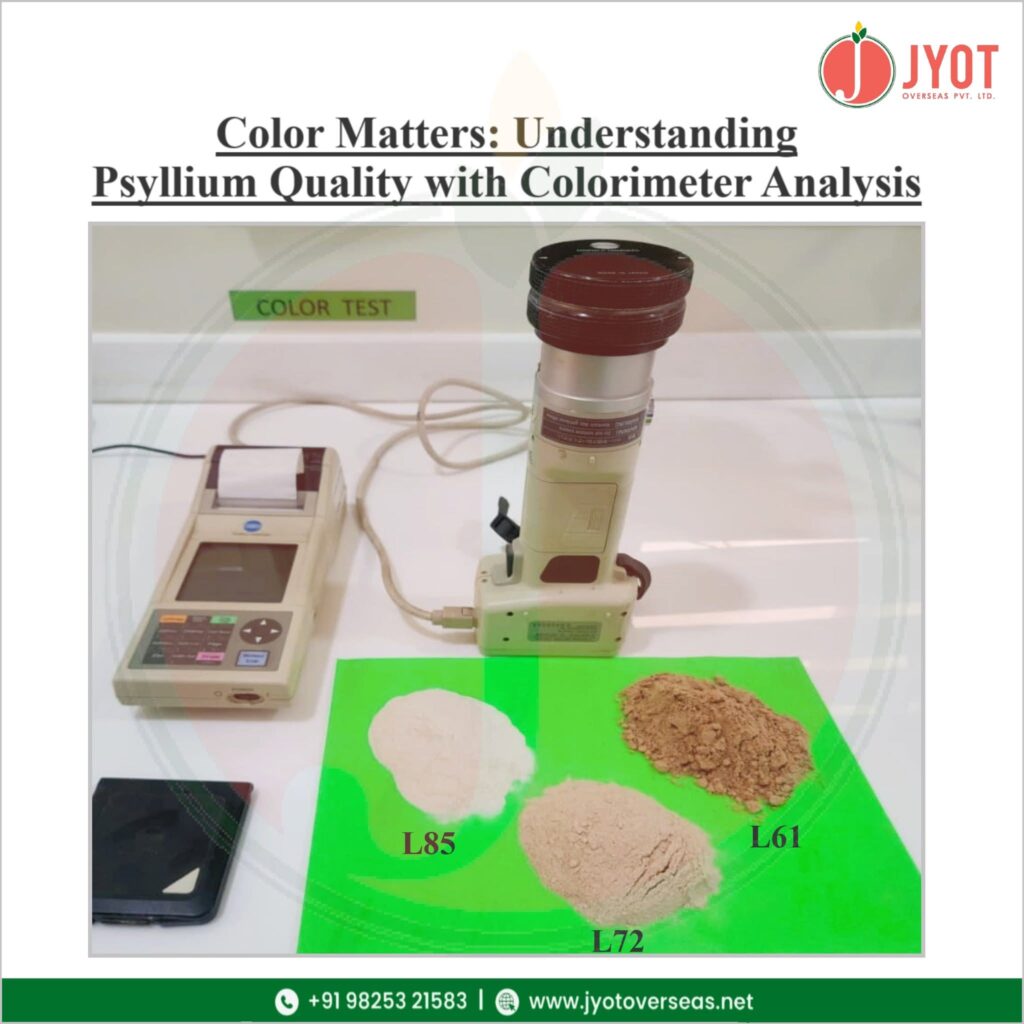
One of the most widely used instruments for this purpose is the Konica Minolta Colorimeter, which measures color using internationally recognized color scales. This approach eliminates subjective judgment and provides accurate, repeatable results from batch to batch.
Among the various color parameters measured, the most important for psyllium evaluation is the L value, which represents lightness.
Understanding the L Value
The L value is a numerical measurement that indicates how light or dark a sample appears.
A higher L value indicates:
- A whiter appearance
- Better visual uniformity
- Cleaner product presentation
- Higher perceived purity
Conversely, a lower L value indicates a darker appearance, which may be associated with higher levels of residual impurities, less refined material, or variations in raw material quality.
For this reason, the L value is widely used as a practical benchmark for assessing consistency across psyllium batches.
Why Color Consistency Matters
In many industries, appearance is an important component of product quality.
Manufacturers producing dietary supplements, functional foods, pharmaceutical formulations, and health-focused consumer products often seek ingredients that maintain consistent visual characteristics throughout the production cycle.
A stable and higher L value can contribute to:
Better Visual Appeal
Lighter-colored psyllium is generally preferred in applications where ingredient appearance influences the final product presentation.
Greater Batch-to-Batch Consistency
Consistent color measurements help manufacturers ensure uniformity across production runs, reducing variation and improving process control.
Higher Perceived Purity
Customers frequently associate a whiter product with superior cleaning, processing, and quality standards.
Suitability for Premium Applications
Food, nutraceutical, and pharmaceutical manufacturers often prefer psyllium grades that demonstrate both functional performance and visual consistency.
Color as Part of a Comprehensive Quality Evaluation
Although color is an important quality parameter, it should never be evaluated in isolation.
Leading buyers and quality teams typically assess psyllium using a combination of specifications, including:
- Purity levels
- Swelling capacity
- Mesh size
- Microbiological parameters
- Moisture content
- Particle size distribution
- Colorimeter analysis
Together, these measurements provide a more complete understanding of product quality and suitability for specific applications.
Meeting Global Quality Expectations
As global demand for premium psyllium ingredients continues to grow, importers are increasingly seeking suppliers that can demonstrate consistency through objective quality measurements.
Established psyllium husk manufacturers India and internationally recognized psyllium husk suppliers are investing in advanced quality control systems to ensure uniformity across batches and compliance with customer specifications.
For companies sourcing bulk psyllium husk for food, nutraceutical, or pharmaceutical production, parameters such as color consistency have become increasingly important alongside traditional quality metrics.
Similarly, buyers of organic psyllium husk often expect strict quality monitoring to maintain both certification requirements and product consistency.
As trusted psyllium husk exporters India and experienced ispaghula husk exporters continue serving global markets, objective quality tools such as colorimeter analysis play a growing role in supporting customer confidence and long-term supply relationships.
Conclusion
Color is far more than a visual characteristic—it serves as a valuable indicator of quality, consistency, and processing standards in psyllium husk powder.
Through scientific measurement using colorimeter technology, manufacturers can accurately assess batch uniformity and monitor product quality over time. The L value, in particular, provides a reliable benchmark for evaluating lightness and supporting quality assurance programs.
While color should always be considered alongside other critical specifications, a higher and more consistent L value remains an important marker of premium psyllium quality, helping manufacturers meet the expectations of today’s global food, nutraceutical, and pharmaceutical industries.
📩 Connect with us:
Exports@jyotoverseas.net
🌐 Website:
www.jyotoverseas.net