
Mesh Size Matters: Understanding the Impact of Particle Size on Psyllium Husk Powder Performance
Psyllium husk powder is valued worldwide for its exceptional water absorption, gel-forming ability, and functional fiber content. While purity is often the first specification buyers evaluate, mesh size is another critical quality parameter that directly influences product performance.
For manufacturers of dietary supplements, functional foods, pharmaceutical formulations, and fiber-enriched products, understanding the relationship between mesh size and swelling behavior is essential when selecting the right grade of psyllium husk powder.
What Does Mesh Size Mean?
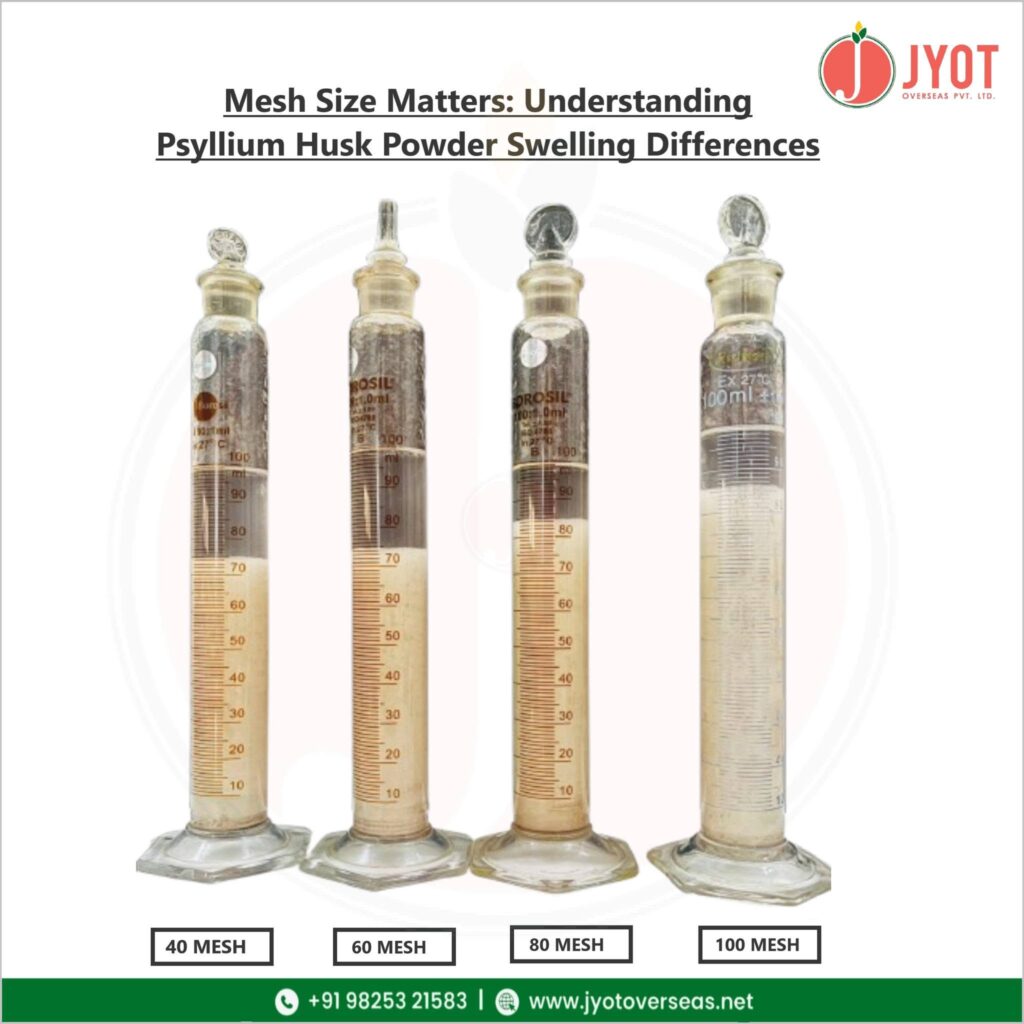
Mesh size refers to the fineness of the powder after milling and sieving. As the mesh number increases, particle size becomes finer, creating a larger surface area available for water interaction.
Commercial psyllium husk powder is commonly available in grades such as 40 Mesh, 60 Mesh, 80 Mesh, and 100 Mesh, with each grade offering distinct functional characteristics.
Why Mesh Size Influences Swelling Performance
The unique functionality of psyllium comes from its ability to absorb water and form a viscous gel. Since hydration begins at the particle surface, finer powders generally allow faster and more efficient water absorption.
As particle size decreases, the powder exhibits:
- Faster hydration
- Improved dispersion in liquid systems
- Enhanced gel formation
- Greater swelling capacity
- More consistent functional performance
These characteristics can significantly affect the final performance of food, nutraceutical, and pharmaceutical formulations.
Comparing Different Mesh Sizes
40 Mesh – Coarser Grade
Coarser psyllium husk powder offers a lower surface area, resulting in slower hydration and moderate swelling performance. These grades are often selected for applications where rapid gel formation is not a primary requirement.
60 Mesh – Balanced Functionality
60 Mesh powder provides improved hydration and dispersion while maintaining a balanced particle structure. It remains one of the most widely used grades across food processing applications.
80 Mesh – Enhanced Performance
With increased fineness, 80 Mesh powder delivers stronger swelling characteristics, improved dispersion, and faster gel development. It is frequently preferred for nutraceutical and functional food products where consistency and performance are important.
100 Mesh – Premium Functional Grade
Ultra-fine 100 Mesh powder offers maximum surface area exposure, allowing rapid hydration, superior dispersion, and the highest swelling potential. This grade is particularly suitable for premium nutraceutical and pharmaceutical applications requiring precise functionality.
Selecting the Right Grade for Your Application
The ideal mesh size depends on the intended end use.
Food manufacturers often seek a balance between processability and functionality, while nutraceutical and pharmaceutical producers typically prioritize swelling efficiency, consistency, and rapid hydration characteristics.
For products marketed as clean-label, plant-based, or fiber-enriched formulations, selecting the appropriate mesh size can significantly influence texture, viscosity, and overall consumer experience.
Meeting Global Quality Expectations
As demand for digestive wellness and functional fiber ingredients continues to grow, buyers are placing greater emphasis on technical specifications beyond purity alone. Swelling performance, particle size consistency, traceability, and processing standards have become increasingly important considerations when sourcing psyllium ingredients.
Leading importers today expect suppliers to provide not only quality material but also technical guidance regarding the most suitable grade for their application. This is particularly true for customers sourcing conventional and organic psyllium husk for regulated international markets.
India continues to be the world’s primary source of psyllium products, with established psyllium husk manufacturers India serving food, nutraceutical, pharmaceutical, and industrial sectors across the globe. As one of the major origins for psyllium processing, the country also remains home to some of the most experienced psyllium husk exporters India and ispaghula husk exporters, supplying customers in more than 100 countries.
Whether purchasing container quantities of bulk psyllium husk for manufacturing or sourcing through psyllium husk wholesale distribution channels, understanding mesh size specifications can help buyers optimize product performance and maintain formulation consistency.
Beyond Specifications: Performance Matters
While certificates, purity levels, and regulatory compliance remain essential, the true value of psyllium husk powder lies in its functional performance. Mesh size plays a direct role in determining how efficiently the product hydrates, swells, disperses, and ultimately performs in the finished application.
For this reason, leading psyllium husk suppliers increasingly work with customers to recommend the most appropriate mesh grade based on product objectives rather than focusing solely on standard specifications.
Conclusion
Mesh size is a key factor influencing the functional characteristics of psyllium husk powder. As particle size becomes finer, swelling capacity, hydration efficiency, and gel-forming performance generally improve, creating significant advantages for food, nutraceutical, and pharmaceutical applications.
Understanding these differences enables manufacturers to select the right grade for their formulations and achieve more consistent product performance. In today’s competitive marketplace, choosing the correct mesh size is not simply a technical decision—it is an important step toward delivering superior quality to the end consumer.
📩 Connect with us:
Exports@jyotoverseas.net
🌐 Website:
www.jyotoverseas.net