
Gel Formation Test: A Key Indicator of Psyllium Husk Powder Quality
When evaluating psyllium husk powder, specifications such as purity, mesh size, swelling capacity, and color are commonly used to assess quality. However, another important parameter often utilized in quality control laboratories is the gel formation test.
Since psyllium is primarily valued for its unique ability to absorb water and form a viscous gel, assessing its gel-forming behavior provides valuable insight into the product’s functional performance. For manufacturers operating in food, nutraceutical, and pharmaceutical sectors, gel formation testing serves as an important tool for verifying both quality and consistency.
Why Gel Formation Matters
The functionality of psyllium husk powder is closely linked to its soluble fiber content, which hydrates upon contact with water and forms a characteristic gel structure.
This natural gel-forming property is responsible for many of psyllium’s applications across industries, including:
- Dietary supplements
- Functional foods
- Fiber-enriched beverages
- Nutraceutical formulations
- Pharmaceutical products
As a result, evaluating how a psyllium sample behaves during hydration provides a practical assessment of its overall performance.
What is a Gel Formation Test?
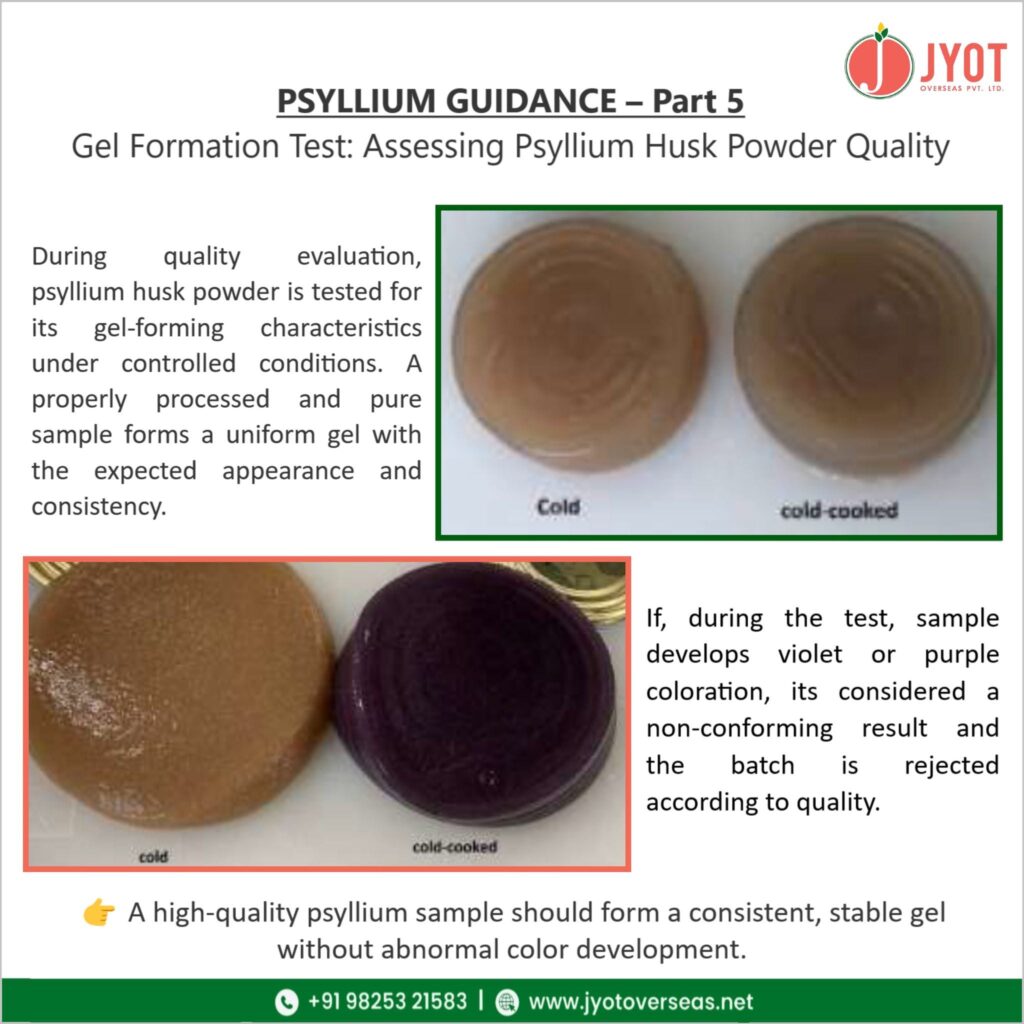
A gel formation test is a quality control procedure used to observe the hydration characteristics and gel development of psyllium husk powder under controlled conditions.
During the test, a measured quantity of psyllium is mixed with water and observed for:
- Gel strength
- Consistency
- Uniformity
- Stability
- Visual appearance
The objective is to verify that the product develops the expected gel structure while maintaining a stable and uniform appearance.
Evaluating Gel Quality
A high-quality psyllium sample should demonstrate predictable and consistent behavior during hydration.
Key characteristics typically include:
Strong Gel Formation
The sample should absorb water efficiently and develop a well-defined gel structure, indicating good functional performance.
Uniform Consistency
The resulting gel should appear homogeneous without excessive separation, irregular texture, or uneven hydration.
Stable Appearance
Visual stability is an important aspect of quality assessment. The gel should maintain a consistent appearance throughout the evaluation period.
Conformance with Quality Standards
Results should align with established product specifications and internal quality benchmarks.
The Importance of Color Stability
Beyond gel strength, quality control teams often evaluate the appearance of the gel itself.
A compliant psyllium sample should form a stable gel without abnormal color development. Significant color changes may indicate variations in raw material quality, processing conditions, or other factors requiring further investigation.
For this reason, gel formation testing is often used alongside color evaluation, swelling analysis, and purity testing as part of a comprehensive quality assessment program.
A Functional Test with Practical Relevance
Unlike certain laboratory measurements that focus on individual specifications, gel formation testing provides a direct observation of how psyllium performs during hydration.
This makes it particularly valuable for manufacturers producing products where texture, viscosity, consistency, and fiber functionality are critical quality attributes.
Food manufacturers, nutraceutical brands, and pharmaceutical companies frequently consider such performance-based evaluations when selecting suppliers and approving raw materials.
Quality Control in the Global Psyllium Industry
As demand for premium psyllium ingredients continues to increase worldwide, buyers are placing greater emphasis on performance validation and batch consistency.
Leading psyllium husk manufacturers India and established psyllium husk suppliers increasingly incorporate functional testing into their quality systems to ensure that products meet customer expectations beyond standard specification sheets.
Whether sourcing bulk psyllium husk for industrial processing or purchasing through psyllium husk wholesale channels, international buyers seek confidence that the product will perform consistently in real-world applications.
This is particularly important for manufacturers utilizing conventional or organic psyllium husk in highly regulated food, nutraceutical, and pharmaceutical environments.
As trusted psyllium husk exporters India and experienced ispaghula husk exporters, quality-focused suppliers recognize that performance testing plays a vital role in supporting product reliability and long-term customer satisfaction.
Looking Beyond Individual Specifications
No single parameter can fully define psyllium quality.
A comprehensive quality evaluation typically includes:
- Purity analysis
- Swelling capacity testing
- Mesh size verification
- Colorimeter assessment
- Microbiological testing
- Moisture analysis
- Gel formation evaluation
Together, these quality control measures provide a more complete understanding of product consistency, functionality, and suitability for specific applications.
Conclusion
The gel formation test is an important quality assessment tool that helps evaluate the functional performance of psyllium husk powder. By observing gel strength, consistency, stability, and appearance, manufacturers can gain valuable insight into how the product is likely to perform in practical applications.
A high-quality psyllium sample should demonstrate strong gel formation, uniform consistency, stable appearance, and compliance with established quality standards. When combined with other critical quality parameters, gel formation testing helps ensure the reliability and consistency expected by today’s global food, nutraceutical, and pharmaceutical industries.
📩 Connect with us:
Exports@jyotoverseas.net
🌐 Website:
www.jyotoverseas.net